Category Archives: Uncategorized

Short news: 3D London soon? ESRI ArcGIS Explorer soon?

  • It looks like we can expect a fully 3D version of London in the coming weeks. I can’t wait.
  • GoogleMapsMania points to BuddyMapping, a web app that uses Google Maps to let users build guestbooks for their sites. Comes with a KML version for viewing.
  • Beginning Google Maps Applications, the blog of the book, has a nice tutortial out about how to crawl and parse XML and HTML pages to turn them into KML. (Via Google Earth Blog)
  • Eagle-eyed Digital Geography spots a download button on the ESRI ArcGIS Explorer home page, and some interesting hints as to what kinds of maps will be available. Alas, no actual downloads are in sight, but surely this means it can’t be much longer to wait?
  • James Fee predicts ESRI ArcGIS Explorer won’t be a “Google Earth killer” in the sense some people imagine it. I certainly don’t hope this is the sound of expectations being lowered. I want as many geobrowsers to play with as possible.
  • Over on Lasting News, Laurent is all over the latest periodic outburst from an Indian official regarding the threat of Google Earth to national security, as reported by India’s Express News Service on August 12. This time, it’s Air Chief Marshal S. P. Tyagi’s turn. Laurent does all the explaining in his post as to why the claim is absurd.
  • Looks like Google Earth was inaccessible again in Bahrain yesterday.

PS: I just noticed that a couple of comments were caught in an over-eager spam filter. It’s now been turned off. Apologies.
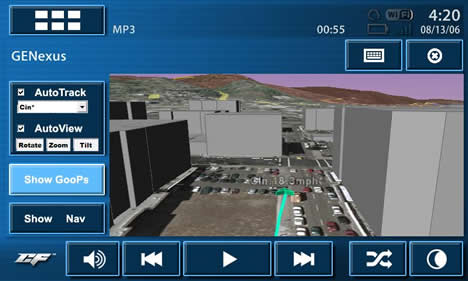
DIY in-car navigation with Google Earth

On my way back from San Francisco to London I again had plenty of time to ponder how Google Earth would do a better job at in-flight tracking than the same standard visualization we’ve been familiar with for what must be a decade now. The current stuff look seriously aged.

Another place where Google Earth is an obvious fit is for in-car navigation and tracking. Volkswagen has already shown us a compelling working prototype, but who knows when that will make it to market.

No need to wait. Over in MP3Car.com’s forums, Ryan McCormick has created a Google Earth skin for a touchscreen interface or tablet PC that lets you use Google Earth as an in-car navigator today.

carge.jpg

The installation process doesn’t look idiot-proof (I haven’t tried it myself) and it works best with version 3 rather than with 4 beta. But for everyone who is adventurous (and has a touchscreen or tablet PC and a 3G modem and a GPS device and perhaps even a car) this looks like a hack well worth exploring.

How is it done? Ryan used AutoIt for the scripting part, his own SKINBedder for the buttons that frame Google Earth, and GooPS for the GPS tracking. There is a whole subculture for adapting PC applications for car computers — more here about that niche.

Science Foo Camp talk examples

I gave a presentation this morning at Science Foo Camp entitled “The rise of the geobrowser – cool uses in science”. A good broadbased discussion ensued, so much so that I didn’t quite make it through all the examples I intended to show off. I did promise to list them here, however, so here are some of the best examples of:

A sensor web: Atlantic buoys

A citizen scientist sensor web: Lightning maps

Science outreach: Gombe chimp blog (new functionality soon)

History of science: Shackleton’s expedition

Science news: Carteret Atoll

Geospatial wiki: Geonames

Georeferenced database: Global volcanism

Server-side analytics: Gulf Impact

Way out-there visualizations and hacks in the service of science:

Avian flu map

Darling-Murray river stream flow data

Treebase

Tree map

I’ll be flying on Monday, so this blog will continue to see neglect until Tuesday…

Short news: Left Coast edition

It looked dubious at times, but I did manage to travel yesterday from London to the US (of all days!) and made it to San Francisco today, where I’ll be at the bottom of the food chain at Science Foo Camp. Some of the discussions will surely be about geospatial data visualization, and the role geobrowsers are playing in democratizing access to such data. If anything relevant to Ogle Earth’s brief happens, I’ll blog it here, of course. In the meantime:

Turn online collaborative spreadsheets into live KML (!)

Valery35 and KASSPER over on Google Earth Communty pull off a great hack. Using the online collaborative spreadsheet service www.editgrid.com, they’ve managed to create spreadsheet-driven KML that can be linked to directly from within a network link.

It took me a while for the implications to sink in, but boy what implications. Import any old spreadsheet with coordinate or placename data into editgrid, add a sheet or two with wrapper KML code, use the concatenate formula to wrap the data into the valid KML code, put the end result in one cell, and then link to it directly from a network link via a cell-specific URL. Presto — your spreadsheet returns KML via some clever templating. No programming required.

What’s more, the spreadsheet can be altered collaboratively, and the results will change live for users, as soon as the network link is refreshed.

The best early example is this spreadsheet by Valery, where the data is concatenated into valid KML in cell K12 of sheet 4. Put that latter link into a network link in Google Earth, or just stick it into Google Maps, like so. Awesome, and I’m not using the term lightly.

The main innovation here (in addition to the great idea) is that editgrid.com gives individual spreadsheet cells unique URLs, and that these return the value of the cell. I could not find an equivalent feature in Google Spreadsheets (despite having a good look around). This is a clear case of convergence outpacing Google’s own inhouse efforts.

Bahrain: Censorship redux

TradeArabia follows up on the decree by Bahrain’s Minitrue Information Ministry to block access to Google Earth’s data servers in the country.

It would appear that the order came from the Information Minister himself, Dr Mohammed Abdul Ghaffar, and that no explanation was given for the decision. All this makes criticism of the move as easy as shooting fish in a barrel; Bahrain Internet Society chairman Ahmed Al Hujairi obliges:

They (the government) had previously said that they wanted to block sites that were against Bahrain’s values, such as porn sites, but why did they block Google Earth?

(Indeed, Mahmood’s Den reported last week that Bahrain began blocking what authorities called “material against the local culture, religion, politics or societal norms”.)

(The New York Times mentions the blocking of Google Earth in Bahrain in passing in this article on Arab reformers.)

Yesterday, Mahmood posted again on censorship in Bahrain, but I want to correct him on a perception he shares with many users that Google censors its imagery, ostensibly at the request of various governments.

Google doesn’t censor. Google licenses imagery from satellite and aerial data providers such as DigitalGlobe, Aerodata and The Geoinformation Group, or gets it for free from public companies like Grafcan. It is the data providers, however, that are bound by the censorship laws of the country they launch from (in the case of satellite imagery providers) or operate in (in the case of aerial imagery providers). Google is free to shop around for the best, least censored data it can find, and with each data update, there are on the whole fewer and fewer censored areas.