Jin-class submarine found in Google Earth. But when? and where?

Isn’t it annoying when everyone and their Drudge links to an article by the Federation of American Scientists noting the discovery of a new class of Chinese nuclear submarine on Google Earth, without actually linking to the submarine in Google Earth? It’d be like mentioning the existence of a cool new website but forgetting the URL. Ogle Earth will have none of it:-) Here it is.

subjin.jpg

And as it turns out, “Panther37” on Google Earth Community identified the very same submarine as a Jin-class way back in July 2006, a year before the “experts”.

Perhaps even more interesting is that the placemarks that started that paricular GEC thread were subsequently removed, with the thread initiator commenting “I won’t go into the reasons here why”. Gotta love the Google Earth Community base layer and the wisdom of its crowds, even despite occasional (self?-)censorship.

Leica Titan (beta)

Seven months after it was “unannounced”, Leica Titan is now available for download as a public beta (Windows only), reports GCN. So what is Leica Titan?

“Leica Titan is positioned as a social network for sharing geospatial data, whether it’s imagery, terrain, features [or] 3-D models,” said Mladen Stojic, director of enterprise products at Leica. “We assume that individuals and organizations around the world have geospatial data that they want to share. Leica Titan is similar to some of the other media-sharing applications that we have for sharing music, pictures and other media files.”

Aha, so it’s a peer-to-peer geospatial filesharing application similar to Napster of old or Gnutella? It’s a bit more than that. Yes, you can share individual files with others that are online, but the coolest thing about Leica Titan is that it lets you load up various geospatial files to your own globe, called your “MyWorld”, and then share that globe with others that are logged into the network. You’re not quite sharing the live state of your virtual globe, as you have to publish a version, but it is getting there.

But why use P2P for sharing states and geospatial files? In the case of most music and movie files, people use P2P because these files are being shared illegally, and owners of central file servers would get sued by copyright owners. In other cases, P2P makes it more difficult for authoritarian governments to control the free flow of information. Is that Leica’s justification for it’s geo-P2P solution? No:

“We’re bypassing the need for a heavyweight server application and facilitating users within the social network to immediately share data for emergency response, where they really need that data turned around rapidly as opposed to having to wait for some IT manager to upload it onto a server, publish it and then tell everyone it’s available,” said Stojic.

Couldn’t that problem be solved more robustly by putting an automated centralized file server online? Google Earth Community and 3D Warehouse serve as models, minus the permissioning. P2P scales horribly. In case of a large-scale disaster involving many respondents, is P2P really the best solution, instead of, say, relaying to a server and then multicasting? And is requiring a Windows machine such a good idea in a disaster scenario, instead of, say, focusing on a cross-platform or web-browser accessible solution?

Regardless of the merits of P2P publishing for this kind of content, I think the concept behind sharing the state of your virtual globe certainly carries a big appeal and can be very useful, not just in disaster response scenarios but when making presentations remotely, whether for business or to grandparents. Indeed, Unype 0.2 for Windows lets you share individual KML and 3D Warehouse files in Google Earth.

Down the line, however, what I would really like is a robust solution where I can reveal the contents of “My Places” in Google Earth, perhaps by having it be linked to my Google account and mirrored on Google servers (just like my Gmail, where space does not appear to be a problem), and also update live the current object of my attention, as GE Sharing does.

Must-read: Avi’s “How Google Earth [Really] Works”

Run, don’t walk, to one of the best articles yet written about how Google Earth does its magic:

How Google Earth [Really] Works

It is written by Avi Bar-Ze’ev, who was one of the developers on early versions of Google Earth, when it was still Keyhole Viewer. He starts off his series by looking at how Google Earth renders a 3D virtual globe, and he does this by explaining the various concepts underlying Google’s patent applications, some of which have been made public only recently.

(BTW, Avi also got a long response from NY State Assemblyman Michael Gianaris regarding his desire to censor imagery of infrastructure in Google Earth.

I think he still doesn’t get it — his argument is just wish-thinking: Google isn’t obligated to buy from (potentially censored) US imagery providers; the company could just as well buy it from foreign providers. And if Google and other US companies were compelled to censor their imagery or prohibited from using foreign providers, then there are plenty of map and globe competitors abroad that will and can provide the imagery.

Removing such imagery from Google Earth means that only those who are the most motivated get access (e.g. terrorists, who can use a number of alternate sources and who often have rogue government support) while concerned citizen loses a resource. Want to check if the local power plant is obeying zoning laws? Not if Google Earth has blurred it. Google Earth and other mapping services like it provide checks and balances for the public on their government. If that is taken away, then the terrorists have already won, to overuse that phrase.)

Links: More 3DVia, ArchiCAD to 3D Warehouse, Map Jack, OZ Jaws

  • 3DVia redux: Not content to just have Microsoft adopt its 3DVia technology to build a 3D Warehouse competitor, Dassault Systemes is also teaming up with Publicis Publishing group to create the password-esquely named 3DSwym, which will focus on something called “consumer journey management”, which I think means getting people to to interact with consumer goods packaging in 3D as it is being developed in order to get feedback from them and thus create something that they really want. Caveat Edsel? Still, another case of using 3DVia to keep metadata with the 3D model throughout the production pipeline, which is the future of such systems.
  • 3D Warehouse2ArchiCAD: First Photoshop CS3 Extended got a plugin for retrieving content from 3D Warehouse, now Graphisoft’s ArchiCAD 11 gets the same functionality. Cadalyst has the news, and instrucitons.
  • GE Security: Avi Bar-Ze’ev offers to explain to NY State Assemblyman Michael Gianaris why his security concerns regarding Google Earth are unfounded. Also, as of now he is putting his technology posts up on Reality Prime, so update your readers.
  • Another Street View competitor: Map Jack. One sentence review: Higher resolution pictures but with a less fluid GUI that Street View, and currently for San Francisco only, so it will be interesting to see how this scales. (Via 3PointD)
  • Picasa Mashup: On the Maps API Blog, Pamela Fox explains how to mash up Picasa with Google Maps by creating a route for a georeferenced Picasa album. I’ve spent the last few days trying to add a traveling salesman solution to the code, but no luck yet. You’ll be sure to hear about it if I do:-)
  • Ozzie Jaws? Somebody’s been scouring Sydney’s Australia Day high resolution images available in Google Earth, and suspected two of the surfers are really a shark and a stingray. The news made it to Sydney’s Daily Telegraph. The pictures in the article are not all that clear, so here are the placemarks; check for yourself. I think the shark’s a good candidate, but the stingray — no way. (Best viewed in Google Earth, not Maps — Maps doesn’t let you get close enough.)

Got UAV data? AGI tools turns it into KML

AGI makes Satellite Tool Kit, an astrodynamics application for designing, visualizing and analyzing air and space flight. It does a lot of heavy lifting for government agencies, the military, and civilian aircraft manufacturers.

One use is the planning of flying unmanned flying drone (UAV) missions and the analysis of gathered data. Not everyone has an STK system installed, however, so now there is a utility that exports that data (and stuff like it) to KML. It’s shown in action in this YouTube video:

Watch it even if just for the eye-candy of seeing how STK’s virtual globe works. Can’t wait for this kind of augmented reality prowess to show up in Google Earth:-) Okay, maybe we’ll have to wait a couple of years.

Google Maps gets (awesome) directions upgrade

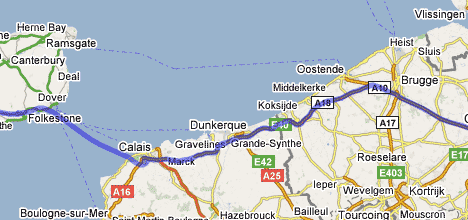
Google Maps just got a jaw-droppingly impressive upgrade to its directions functionality. Just watch the YouTube video already:

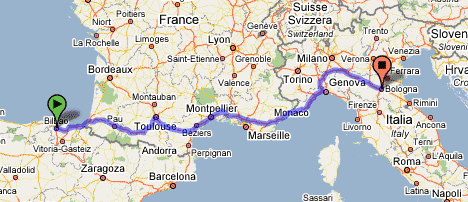
You have to play with it to believe it. And it works in Europe too, across countries:

gmapsupg.gif

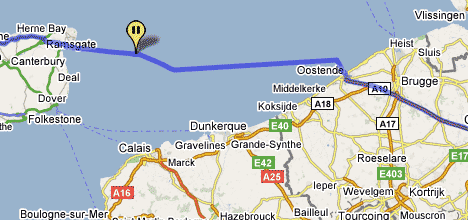
And it handles ferries seamlessly:

gmferry1.gif

gmferry2.gif

I have no idea how the algorithm for finding routes does its work so fast, or how address labels get to be displayed on the fly as you drag a destination around, but this bit of AJAX programming is simultaneously technically stunning, useful, and easy to use.

NY state officials think Street View has security implications

From the Department of Paranoid Officialdom:

The NYT reports: Google Earth Makes Some Officials Nervous. Apparently, Microsoft and Google vans have been scouring NYC for their street view products, and this has been making low-level officials nervous.

This morning, the state comptroller, Thomas P. DiNapoli, held a news conference in Midtown Manhattan to urge Internet-based mapping services to consult with law enforcement authorities — and well, to just be responsible — in deciding what to put on the Web. Citing Google Earth among other services, he said he was worried that too much information might compromise counterterrorism efforts.

Right. Because terrorists are too stupid to drive cars and take pictures themselves. (Some of the comments attached to the article are priceless.)