Category Archives: Uncategorized

Google eArt II

Little did I know that when I titled my last post about the intersection of art and virtual reality “Google eArt”, I’d get every misspelled google search end up on this blog. So here goes another installment:

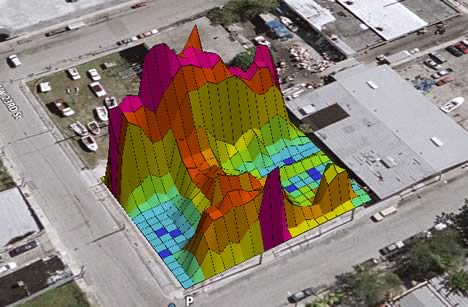
The electromagnetic field of a Florida substation was turned into an installation piece made to scale by Locust Projects Nicolas Lobo at the Locust Projects art space:

nicolas_lobo2.jpg

Of course, the project wouldn’t be complete without its virtual complement in Google Earth:

emf.jpg

Here is the KMZ file. Geospatial context as art. Love it.

And then there were nine — Netherlands gets address search

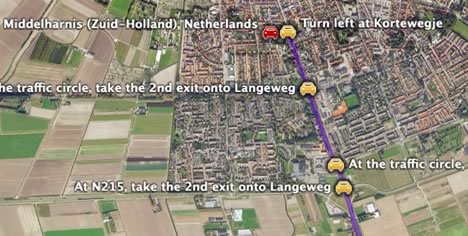
Webmapper reports that maps.google.nl is now live. A quick check reveals that Google Earth now also does directions between specific addresses in the Netherlands:

netherlandsroads.jpg

Webmapper goes on to list content partners for restaurant reviews in Google Maps — these haven’t made it to Google Earth yet. In case were keeping tabs, it’s now the UK, France, Germany, Italy, Spain and the Netherlands that get “full-service” coverage in Europe, in addition to Japan, Canada and the US. (Semi-interestingly, the UK, Canada and the Netherlands only get directions at the moment in Google Earth — no yellow-pages type content.)

Short news: Hidden Google Maps support in iPhoto?

  • Interesting: Craig Stanton pointed me in the direction of this find: a post on a MactelChat bulletin board, “iPhoto 6.0.5 shows evidence of Google collaboration“. It could be an unauthorized easter egg, but there appears to be a hidden button that links EXIF in iPhoto to a view in Google Maps.
  • Bizarro reporting by Turkish news source Zaman:

    While a middle-aged man was sunbathing on his balcony, he was caught by one of the Google Earth users. A photograph taken by the user was published on the Internet. After a while, photos of women that were taken secretly were published on the Google Earth Forum. A Dutch woman was sunbathing on the roof of her house in the Hague. Photos of many people, taken secretly, began to be published on the Internet.

    Yep, that’s definitely how Google Earth works — when we fly around the globe at home, an actual satellite obeys our every whim, live.

  • A web-based resource for geoscience visualizations by the Science Education Resource Center at Minnesota’s Carleton College gives a good overview of Google Earth and its many uses in geoscience for visualizing data.
  • Rich Gibson, co-author of Mapping Hacks (published by O’Reilly) is not happy about having gotten a “take-down letter” from Google regarding some code available online that he wrote that let you download Google Maps tiles.

Have I got a CAGE for you!

What has the Indian government been up to regarding Google Earth since the last time we checked? The Hindustan Times provides an update. On October 2, it reported:

Sources said that at a high-level meeting convened by Cabinet Secretary BK Chaturvedi in September, it was proposed that the Ministry of External Affairs (MEA) should raise the [Google Earth] issue with the US at a bilateral level. […] New Delhi believes that there should be an international agreement that before satellite pictures are taken over a particular country, the permission of that country has to be taken.

That’s a brilliant idea. How might that work in practice? Let’s explore with this one-act play:

LOCATION: GOOGLEPLEX, MOUNTAIN VIEW, CA

TIME: SOMETIME IN THE NEAR FUTURE

ENTER STAGE LEFT — GOOGLE EARTH CTO MICHAEL JONES, WITH MOBILE PHONE

JONES IS ON HOLD, HUMMING ALONG TO A MILITARY MARCH. THEN A MUFFLED VOICE IS HEARD.

JONES: Oh, Hello Mr. Kim Jong Il, thank you for taking my call. It’s just a courtesy call, really. I was just wondering if it would be allright to add some new satellite imagery of your country’s lovely natural resources to our virtual globe, Google Earth. I’m guessing it would do wonders for your touri… No? But… [CLICK HEARD] Bastard hung up on me. Okay, who’s next? [HITS THE NEXT SPEED DIAL NUMBER. AFTER A WHILE, IT RINGS, AND SOMEBODY PICKS UP.] Good afternoon, President Bashir. How is Sudan looking today? Look, have I got a proposal for you… [CURTAIN]

Please note that the Hindustan Times article is entitled “Coalition against Google Earth”. That is truly inspired copywriting, and I hope the acronym sticks — after all, who wouldn’t want to join a CAGE?

PS: Google’s PR response team obviously picked up on that article, because the very next day, the same paper carries every argument you can reasonably make as to why public access to satellite imagery is a net public good.

Darfur

dalia.jpg

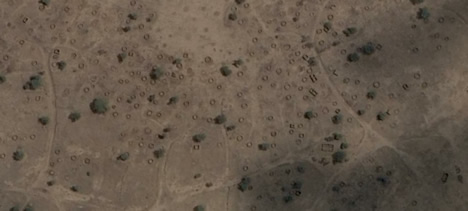
Those circles aren’t animal pens. They’re burned-down gottias, circular mud huts that had straw roofs, and they’re what’s left of Dalia, a village in Sudan’s Darfur region, one of hundreds of villages that have been destroyed by the Janjaweed in a program of depopulation that has killed perhaps 400,000 civilians since 2003.

Today, Google added recent high resolution imagery of Darfur to Google Earth, taken by DigitalGlobe in January-March 2006. It serves as an unequivocal indictment of the Janjaweed, and of the Sudanese government whose implicit support it has enjoyed, because in these new images each and every burned-out gottia is visible. This is the kind of evidence that puts paid to the claims still coming out of Khartoum that the ethnic cleansing is not widespead, and that accusations of genocide are a mere pretext to wrest sovereignty away from Sudan with the deployment of UN peacekeepers.

But this evidence also makes it harder for us remain complacent. We can no longer pretend we didn’t know. A number of humanitarian agencies have been documenting the tragedy of Darfur, mapping burned out villages and recording oral histories in the refugee camps. Some of these data will soon be published as KML — I used pointers from one draft version to highlight 15 of the destroyed villages visible in the imagery released today. Here it is. Zoom in close. This is just a minuscule subset of the devastation in Darfur.

Imagery update: US, London 2006, South Georgia

There is plenty to go see in Google Earth today, as it’s been updated with lots new content, as listed by PenguinOpus on Google Earth Community. There’s new stuff in the US, 10cm-per-pixel imagery of London from early 2006 (taken in winter, no doubt to avoid further exposure to topless sunbathers:-), plenty of new high resolution cities all over the place as well as new strips of high resolution imagery in Darfur (more about that later). As usual, Google Earth Blog has a blow-by-blow account (Look up Burning Man, and compare it to the map overlay).

And South Georgia is no longer blurry, thanks to a gem of an image provided by the British Antarctic Survey (BAS). It is a rare cloud-free Landsat ETM+ image of the island, and it now forms the base layer for South Georgia in Google Earth.

Why is this a Good Thing ™? Because everybody wins: BAS is able to further its mandate by making such imagery available to the public, but at the same time bandwidth costs are carried by Google, which in return gets a better base layer for Google Earth. We of course win, because now we can go follow along with Shackleton’s expedition all over again, and where before things got blurry, they are now in high resolution. And finally, scientists — especially those gearing up for the International Polar Year in 2007-2008 — get a much improved canvas against which to publish their data and discoveries. Earth’s poles remain some of Google Earth’s last terra incognita, but that’s changing bit by bit.

Quality content update: Wikimapia as a network link; new global poverty maps

  • Wikimapia has been an runaway success — it even has a blog dedicated to it, Matt’s Wikimapia Blog. Matt reports that all of WikiMapia’s content is now available as a KML network link. It’s fast, unobtrusive, and works exactly as advertised — making it yet another great source of user-generated geospatial annotation. (Via my comments:-)
  • Columbia University’s Center for International Earth Science Information Network (CIESIN) has just published detailed new global geospatial poverty data, and Declan Butler has turned a subset of them to KML overlays. He’s made a global hunger map, a global infant mortality map, and a detailed poverty map of Palestine, downloadable from his blog. Declan points out that “the underlying GIS data made freely available by CIESIN allows any GIS professional to build upon them by integrating other data.” This should make the eradication of global poverty just a little easier.