Today’s imagery update: Antarctica gets its first close-ups

From a post over on Google Earth Community, today, news of an imagery update that mentioned Antarctica. Finally, the fifth continent gets the high resolution treatment. I had to go take a look.

Yum. Mount Erebus is now in high resolution (albeit without DEM data), as is Australia’s Davis Station and Casey Station, UK’s Rothera, Deception Island (!), China’s Great Wall Station, the South Orkney Islands, and plenty of unmarked high-resolution tiles as well. Christmas has certainly come early for polar scientists. Here’s a quick collection of this new imagery (view it as KML in Google Earth).

(On a side note: Now that there is much higher resolution over parts of Antarctica, a lot of the placemarks turn out to be not so accurate — I wonder if there might not be a mechanism for assimilating/correcting these?)

Here is the official list from Google Earth Community:

New high resolution imagery:

  • Canada: Whistler, BC; Waterloo & Toronto, Ontario; Nanaimo, BC; and

    Fort Saskatchewan, AB

  • England: Base 50cm coverage of nearly entire country, and Avon
  • Germany: Cities/Regions of Greifswald, Trier, Köln, Stuttgart, Bonn,

    Oldenburg, Rostock, Saarbrücken, Hamburg, Hannover, and Ritterhude

  • Austria: Villach region
  • France: Cities of Caen, Dijon, Metz, St Etienne, Toulouse and Rouen
  • Spain: Catalonia and Valencia
  • Andorra
  • US: Imperial County (CA); Yellowstone National Park (WY); Galveston/Houston (TX); Peterborough (NH); Cheyenne (WY); Burke, Wake, and Cabarrus Counties (NC); Racine and Kenosha Counties (WI); Washington, DC; St Paul (MN); and the State of Alabama
  • Japan: City/Regions of Kochi, Asahikawa, Koriyama, Miyazaki, Nagano, Utsunomiya, Akita, and Toyama

Digital Globe:

  • Large Digital Globe (60cm) update includes areas in Sudan, expanded

    Africa, Australia, Mexico coverage and smaller areas of coverage in Asia, Polynesia, South America, Canada, Europe, Middle East plus some

    interesting islands in Antarctica and Greenland.

Updated Imagery:

  • Americas: Bogotá, Columbia; Mission Viejo (CA, US); Hillsborough County (FL, US)
  • EU: Dublin, Ireland
  • Middle East/Africa: Beirut, Lebanon and Tripoli, Libya
  • Asia: Hong Kong and Manila, Philippines

Updated Terrain:

  • Western US 10m
  • Canary Islands 10m

Frank Taylor lists some more specific places. Note also that Germany’s imagery now looks more naturally colored.

(Thanks to Alok Patel, Maria and Jan Wesbuer for writing in.)
Catch-up links 1: Parallels to do 3D; Streetviewr

Catching up and posting here, more for my own sake:

  • One of the reasons that I have not been reporting much on Windows-only 3D virtual globes is because even though I run a Mac that can run Windows natively, 3D graphics acceleration has still required a reboot, because Parallels Desktop didn’t support that feature.

    Until now. Parallels Desktop 3, out in a few weeks, will have support for 3D hardware acceleration, which means I will be able to run Virtual Earth 3D and NASA World Wind in a window on my Mac, properly, just like any other Windows application. (Via Ars Technica)

  • Boing Boing features a cat owner freaked out by the fact that her cat is visible in the window of her home on Google’s new Street View feature. She later features in a New York Times article. Point quietly made: Taking photos from the street is not illegal, but you can in any case exempt yourself using by notifying Google using the map interface.
  • It was a 100% certainty that a blog would spring up documenting interesting Google Street View images: Enter Streetviewr.
  • AutoCAD 2008 expands its KML toolset, including support for timelines. AutoCADder has the details and further linkage.
  • Ron Lake: KML and GML Working Together. Friends again!
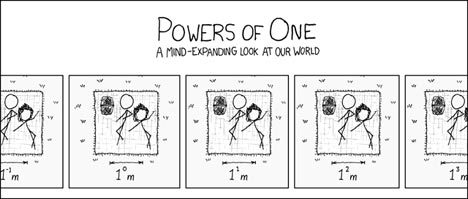
  • An in-joke, but a good one, from the always excellent xkcd.com:

powers_of_one.jpg

Feed Validator now validates KML

Gregor J. Rothfuss, previously of Endoxon but now a Googler, has just given Feedvalidator the ability to validate KML, in addition to RSS and Atom. Here’s what it looks like when I submit one of my own KML files — it is found to be somewhat lacking:-):

fval.jpg

This newfound ability of Feed Validator is not documented anywhere on the site yet — it’s been included in the nightly builds since May 30. Just remember to feed it KML, not KMZ/.It even does KMZ!:-) Practically, Google Earth is a lot more lenient than Feed Validator, though of course the whole point of validators is that they be unforgiving:-)

You can download and run Feedvalidator’s Python code for off-line testing. There are folders in place ready to hold KML 2.2 validation rules, though they do not appear to be fleshed out yet.

Street View: The six-sentence review

[Catching up with the news of the past few weeks:] What I especially like about Google Maps’s new Street View feature is that it is permalinkable, down to the direction you’re looking at. Here is my old apartment at 109 St. Marks Place as a screenshot:

109stmarks.jpg

And here it is as a link. As you’ll notice, addresses are indeed approximate.

Greg Sadetsky gets under the hood of Street View. Finally, a useful Flash application, because it is fast and because it does one thing well. (Via the Daily Ack)

Sweden’s virtual embassy in Second Life: Now featuring Geoglobe

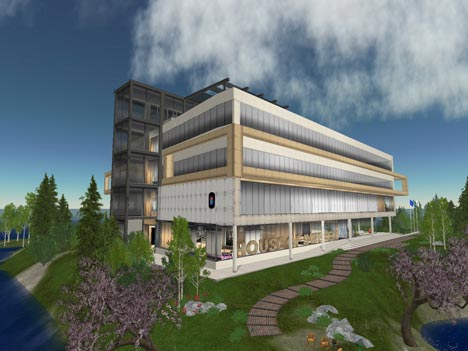
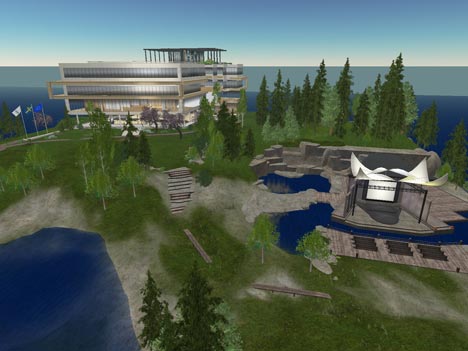
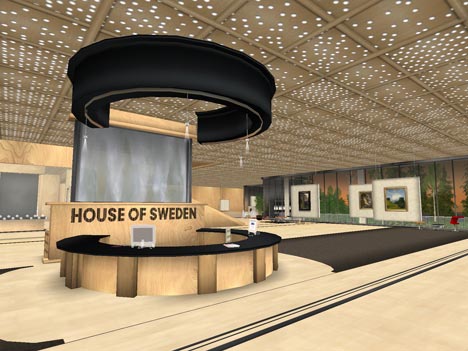
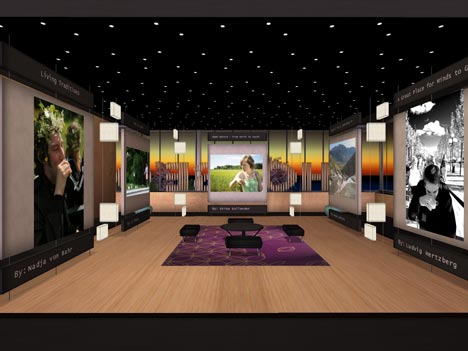
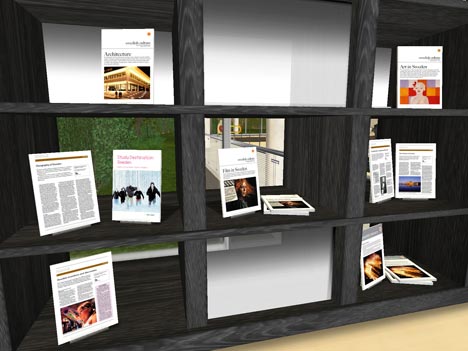
What could possibly justify an 11-day hiatus on this blog? Getting Sweden’s virtual embassy in Second Life out the door in time for an earlier-than-originally-planned press conference with the foreign minister of Sweden, is what. Here are some screenshots of the finished product:

[Scroll down for a geospatial angle to this — it’s not entirely off-topic:-)]

second_house_of_sweden_daylight.jpg

sim.jpg

desk.jpg

sweden_in_images.jpg

printed_information.jpg

And here is a YouTube video of the press conference and inauguration, which had simultaneous feeds between real-life events in Stockholm and in-world events in Second Life:

(Read more about the geek-fest that was the press conference here.)

You may remember that Ogle Earth posted about Geoglobe a few months ago — Josh Knauer and Stephane Desnault’s virtual inverted globe inside Second Life to which you can post geospatial information. I loved it, so much so that we used it in the virtual Swedish Embassy to pinpoint the locations of every real-life Swedish Embassy, with direct links to each embassy’s web site. Here is a YouTube demo featuring Belmeloro DiPrima, my avatar:

Do come visit us in Second Life. If you’ve never been in, you can get a free account and log on directly via www.sweden.se/secondlife. If you already have an avatar, teleport to the Swedish Institute sim.

Google Developer Day 2007: Keynote highlights

[Stefan Lorimer guest-blogs from Google Developer Day 2007. Here is his summary of the keynote.]

Keynote.jpg

Speakers included VP of engineering Jeff Huber, Google data API product manager Paul McDonald, Google Maps and Local Search product manager Thai Tran and Sergey Brin. The keynote speech was broadcast to 10 global cities with 5,000 developers worldwide participating in the conference.

The speech was broken into three major sections: 1) Integrate Google services, 2) Reach Google users, and 3) Build next-gen web apps. Each section featured a product announcement.

For the Integrate section the product announcement was the Google Mashup Editor. It was discussed that AJAX, Javascript, Atom, RSS, caching and parsing on the server were all involved in the process of making mashups. Mashup Editor provides a Sandbox for testing and taking feeds from external sources and creating mashups in as few as 3 lines of code.

There is at this point also the mention of the Gadgets API, which is used in Google homepages for widgets and now will be able to be added in websites. It was also mentioned that ***Gadgets can be added to blogger blogs****. I want a gadget on my blog of a mashup of Frank Taylor’s Google Earth Blog and Stefan Geens Ogle Earth. [:-)]

Next product announcement is Google Mapplets which lets you combine Maps API with Google Gadgets API. This functions by way of an iframe that contains a gadget that inputs data into Google Maps. As a side note, try to implement a Flash app in one of these for some extra bang for your buck. Check out this preview to try it out.

Lastly, there was a mention of Google Web toolkit and the current limits of AJAX.

Picking up on this topic, a new product announcement: Google Gears is demoed, which gives developers offline access for web apps. It is billed as cross-browser, cross-platform and open source, with an evolutionary approach towards working with industry standards. This enables developers to keep using skills that would be based around previous tools such as Javascript API.

It was also brought up that Google Reader would now be functional offline.

Next up an announcement is made of the Gears Industry Collaboration between Adobe, Opera and Firefox. A demo of Flex and Google Gears is given.

[Stefan Lorimer also posted a YouTube video of some new features coming soon to Google Earth:

And here is one of Sergey Brin:

Personally, I’m amazed at how much that was presented at the Keynote has a geospatial component or application. Thanks, Stefan L.!]