Hey, check it out, the US Holocaust Memorial Museum is looking for a full-tme KML production manager, and they’ve posted a job on NeoGeo Jobs. That’s exactly the sort of job that this board is designed to market. Congrats to the USHMM for taking the plunge and being ground-breaking in yet another venture.
Yearly Archives: 2007
Censorship coming to South Korean Google Maps?
South Korea’s government has long been unhappy with the transparency that Google Earth and Maps provides over South Korea (though it doesn’t mind the view of North Korea one bit). Now South Korea’s mainstream news site Chosun.com carries an article that seems to indicate things are coming to a head:
Google Korea said on Sunday that it is in talks with a government agency about security measures in regards to the exposure of national security facilities in satellite photos provided by Google Earth.
A source at Google Korea said that Google’s policy is to show original materials as they are, but, given Korea’s current situation, the satellite map provider will fully incorporate the Korean government’s demands when it starts its Korean satellite photo service in the future.
Whatever could that mean — a “special” censored version of Google Maps, not unlike the way that China’s Google Maps is “special”? Censoring South Korean imagery just for South Koreans would be a phenomenally pointless act, but if that is what keeps the government happy, that’s fine by me:-) Or is the source implying that the next generation of imagery will be censored for everyone?
Mapping the mappers: Usage stats get mapped
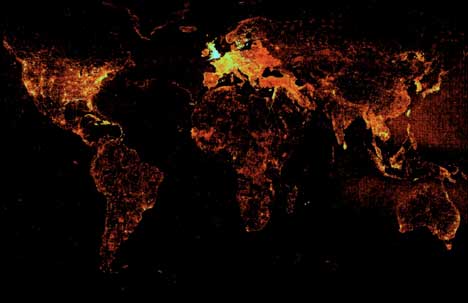
Dan Karran reports from the State of the Map conference held in the UK this past week, mentioning that Google’s Ed Parson’s showed off this map detailing where the most user-generated content was posted on Google’s geodatabase:
Quite by coincidence, this past week also saw Microsoft’s Danyel Fisher show off a map of something not entirely unrelated: Usage patterns for Virtual Earth, based on how often a tile is requested:
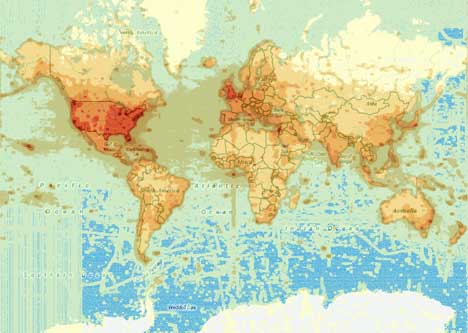
That’s an image I grabbed from Hotmap, Microsoft Research’s resource for this data that just right now appears to be down.
What can we tell from these two maps? That the UK is a popular geosurfing destination and simultaneously a major location for user-generated content, whereas India and China are woefully undermapped by users relative to the population — certainly relative to Southeast Asia — although viewing interest in those two regions appears healthy.
Links: SAMs examined, ImageAmerica’s website, Java geoconverter
- Social spying, cont.: Everything you’ve ever wanted to know about Iran and North Korea’s deployment of S-200 surface-to-air missile systems, courtesy of Sean O’Connor in his IMINT & Analysis blog, using copious screenshots from Google Earth.
- ImageAmerica: Want to know what ImageAmerica did before it was bought up by Google? Here is what their site held in February 2007, courtesy of the Wayback Machine.
- Java geoconverter: Via the comments, “yet another route converter“, this one using the Java Runtime Environment, so it is very multi-platform.
- Cosmic: Barnabu just keeps on outdoing him (her?) self. The latest: Cosmic microwave background radiation on a sphere!
- GPS with iPhone: Does the iPhone do GPS tracking? In a manner of speaking, yes, albeit convolutedly, using an external GPS tracker and Mologogo. Details here.
- Alpine huts: 1,300 Alpine huts and shelters as KML? Should come in handy in a few weeks when I go trekking in the Alps. I hope they’re accurate:-)
- Internet speed: Wishing your virtual globe would download its data faster? Why not go live in Sweden, where we may soon all have 40-gigabit per second download speeds. Yes, you read that right.
- NATO adopts GML as its geospatial reference format.
- DIY GPS: Build your own mobile GPS tracker.
- Mapplet tutorial: A very good tutorial on how to make a Google Maps mapplet.
- 3D on a 2D Map: AfterCAD announces a georeferenced publishing solution for their 3D models that uses Google Maps. Surely that is a mistake, and they mean Google Earth? No, Google Maps-based it is. Click on an icon on the map, and get a popup containing a 3D model. I’m not convinced this web-based mapping solution is as compelling as, say, Microsoft Virtual Earth, though it does work on the Mac.
- NASA: For the record: Google Earth gets default NASA layers.
Oh, say, can you see, Washington DC?
Today’s Washington Post carries a well-written article dissecting the recent update to Google’s geospatial imagery database over Washington, DC.
While most of Washington DC now shows imagery taken by the USGS in 2005, the very center of DC uses older and slightly less detailed imagery by private firm Sanborn, taken in 2002. The reason is that Sanborn’s imagery is not censored, whereas the USGS redacts the White House and other landmarks. Google chose older imagery of the center of DC over newer imagery that has parts of it censored.
The WaPo article gives voice to local cartographer Nikolas Schiller, who first noted the specifics of the update on his blog and who laments the fact that the entire center of DC has to sport older imagery for the sake of avoiding the censorship of just a few buildings:
Schiller said he thinks Google should just use the 2002 map for the small spots the government has censored rather than the whole downtown area.
Why not? It’s a good question. If Google were to pursue such an editorial policy, it would come across as being much more aggressive against any form of censorship, and that is A Good Thing. But then, too, it would have to actually have an editorial policy, and that way lies a slippery slope, with inevitable charges of favoritism, double standards, etc.
Instead, Google’s actions attempt to affect (symbolically, at least) an attitude of laissez faire when it comes to interfering with image tiles. Governments may doctor imagery before it is released, and Google might use it wholesale (as it does in the Netherlands) but Google does not itself mix and match imagery at the sub-tile level. As with Basra in January, when the company replaced an entire series of image tiles with older ones, Google doesn’t micromanage decisions about what may or may not be justified censorship.
The upshot, indeed, is that the only tool Google is left with is a broad brush, and that it sometimes is forced to use it when confronted with governmental censorship as in DC (hence the inability to evade a de facto censorship policy). Soon there will be another option, however: Using those digital cameras and planes Google just acquired when it bought ImageAmerica last week. Perhaps then we will also finally get rid of the pixellation over the Naval Observatory, a favorite bugbear of the conspiratorially minded.
Is there a market for neogeography jobs?
Is there a market for neogeography jobs? The question came up just a few days ago between a friend and I when she lamented the lack of an obvious clearing house for jobs that aren’t of the traditional GIS variety — where you’d enlist people to build a mashup, for example, or turn a database into a KML file, or build a 3D Collada model for Google Earth, or build a KML template for a CMS.
These jobs are more often project-based, and aren’t necessarily fixed to a specific location as they tend to be delivered via the internet… But are there enough of them to create a market?
Let’s find out. Enter Ogle Earth’s NeoGeo Jobs, a job board powered by Simply Hired‘s Job-a-matic, which also runs GigaOM’s job board and that of O’Reilly’s Perl.com.
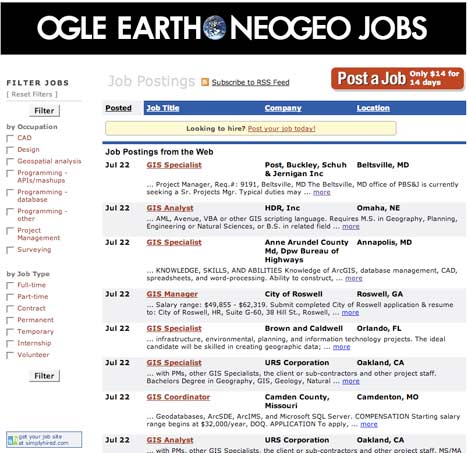
It works like this. If you have a neogeo job that needs doing, you can post it for two weeks at a dollar a day. I’ve set the price far lower than on any other job board, as I’m more interested in seeing if this takes off. (On the other hand, paying something deters spam posts.) Job-a-matic takes half of the revenues in any case:-)
The most recently posted jobs appear in the sidebar of every page of this blog, and there is also an RSS feed of new jobs. At the bottom of the RSS versions of Ogle Earth stories there is a link to the jobs listings page. Furthermore, the jobs enter Simply Hired’s database, so they also get shown on MySpace, FaceBook, etc…
Is Job-a-matic perfect? No. It currently only accepts US credit cards (Doh! They’re working on making it international, they say) and it is skewed towards the types of jobs that are place-specific and permanent, though that doesn’t prevent us from ignoring those quirks.
In the plus column, however, NeoGeo Jobs is already topped up with GIS jobs from Simply Hired’s database, so go have a look, just in case:-)
Ogle Mars
I have been spending some far too much time this past day looking intently at at the absolutely phenomenal sub-meter resolution images taken by the HiRES camera on the Mars Reconnaissance Orbiter, which are freely available for download. The full-resolution JPEG2000 files are whoppers: Some of them easily scale 250MB and half a gigapixel, so if you need an excuse to buy a new computer, this is it.
If your computer can handle them, then do spend some time exploring the library of images — it is the most impressive thing I’ve come across this year, and I’ve been making desktop backgrounds of particularly striking imagery all morning. If you’ve got a 1920×1200 screen, here are some examples (click to download):


(Aside: You won’t see craters with dunes in them on the Moon because the moon has no atmosphere.)
I love it when publicly funded science makes the results available to all. And I cannot wait until this imagery shows up on a virtual globe, with DEMs — will there be a proper Google Mars, or will NASA World Wind have the plugin? (Until then, might the Maps-based Google Mars not make for a good georeferencing solution for the HiRISE image metadata?)
(BTW, Mars has a new mystery. Is this where the Martians are biding their time?:-)