- Geonames.org gets some feedback on its adherence to semantic web standards, and in the process is noticed (and lauded) by some big names — as in Tim Berners-Lee big!
- You may already have seen or used the mouseover effect for icons at points in KML. Now Jason Birch writes a how-to for extending that effect to an entire region, using the MultiGeometry tag.
- By far the most feature-rich and developer-friendly online spreadsheet program, EditGrid, starts playing on Google’s turf: You can add it to your Google personalized home page. (Via EditGrid Developers Blog)
- Christian Spanring plays with the GeoPress plugin for WordPress, and gives some feedback.
Monthly Archives: October 2006
3D Nature puts Matterhorn in Google Earth, makes my day
3D Nature‘s Chris Hanson has made a Matterhorn!
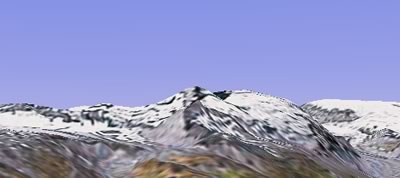
Google Earth sans Matterhorn:
Google Earth avec Matterhorn:
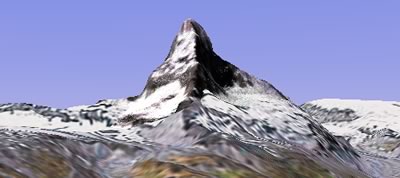
Le real deal:

I am so impressed. Download it now to make Switzerland whole again.
Chris explains all:
The Google Earth 4 Matterhorn demo also shows off the ability to convert terrain into 3D geometry for display. Here, a small patch of 30m DEM data is inserted into the Google Earth environment to demonstrate the lack of detail in the base terrain model. The draped imagery is 30m Landsat, natural-color processed with AlphaPixel’s PixelSense. Since no higher-resolution imagery was available the permitted free redistribution, VNS’s Snow, texturing and fractal subdivision features were used to improve the look of the relatively-coarse imagery and introduce more apparent detail and variation. This project was done in response to Ogle Earth demonstrating the poor resolution of GE’s basic terrain.
Chris got the Matterhorn’s detailed elevation data from Jonathan de Ferranti’s page containing tons of freely downloadable data for many mountain ranges — a real treasure trove. Jonathan even voices an appeal I can only second:
If these files were imported into Google Earth or NASA World Wind, there would be a spectacular improvement in results. If anyone finds some way of doing this, or better still, persuading Google, NASA, Terraserver or ESRI to do this themselves, then please tell me!
Previously on Ogle Earth: New from 3D Nature: Textured terrain using COLLADA, 3D Nature’s 3D trees: Colliding COLLADA standards? (BTW, the rendering problems mentioned in the latter article will be fixed in the next update of Google Earth, I’m told.)
Iran throttles internet access to 128kbps
As Boing Boing reported yesterday, and the Guardian confirms today, the Iranian government has instructed ISPs to limit the bandwidth of internet accounts to 128kbps. The aim: To curb a western “cultural invasion”. Yesterday’s decree follows a crackdown on satellite antennas over the past month.
You have to give those hardliners points for trying. Anything that is bandwidth intensive will now be spectacularly frustrating to do — including using Google Earth.
But if the conservatives’ intention is that Iranians will now merely stop downloading music, movies or imagery, then they’ve got something else coming. Throttling access to the internet by decree is, well, cultural waterboarding. It makes its victims very very angry. And as the Guardian reports, all the signs are that this latest decree is incredibly unpopular.
New official Google blog: Using Google Earth
This post is a no-brainer. John J. Gardiner, a technical writer at Google and the author of the Google Earth user guide, has just launched a new blog (as one does): Using Google Earth. John writes:
The idea is to describe features of Google Earth that might otherwise be unknown to many users. Initially, I will focus on serving less experienced users, but I will discuss more advanced topics soon. I will also post some original KML content for folks to explore. Let me know if there are topics you would like to see addressed on this new blog. Thanks!
Which reminds me: I really need to update my link list.
Short news: Navideo, SketchUp components, paleogeography
- Navideo is software for GPS enabled PocketPC that claims to perform some nifty tricks. You can track other Navideo users in real time, be tracked in turn, or send your position to others via sms/email. Navideo Controller for PC can keep track of multiple clients (using Google Earth), and send them new destinations. I’m sure it’s intended for car fleets, but just think of the real-life games you could build on top of this system…:-) (Via coolsmartphone)
- Simplified Building Concepts is starting up a free SketchUp Library specializing in components and objects to place inside larger projects. You can also upload your own content. It’s in beta, but it looks good.
- Valery Hronusov takes Geology professor Ron Blakey’s renditions of global plate tectonics stretching back 600 million years and wraps them around Google Earth, adding time stamps. His task is made much easier by using EditGrid thus. If you’re wondering whether Google Earth’s timeline supports events 600 million years ago, the answer is No. Valery had to cheat:-).
But one serious question: Is it really at all possible to know where mountain ranges were on these continents half a billion years ago, or are those drawn with a huge dollop of paleopoetic license?
Archaeologists dig Google Earth
Remember Luca Mori? Last year, he discovered remains of a Roman villa while perusing Google Maps. This proved to be an inspiration to UNC-Chapel Hill archaeologist Scott Madry, reports The News & Observer:
After reading about the Italian man’s good luck, Madry got out his laptop, fired up Google Earth and looked over lands in Burgundy near his research area. Google Earth displays that area in particularly good resolution. Immediately he spotted features that, to his trained eye, resembled outlines of Iron Age, Bronze Age, ancient Roman and medieval residences, forts, roads and monuments.
“I’ve spent 25 years in this region of France,” Madry said. “In the whole time, I’ve found a handful of archaeological sites. I found more in the first five, six, seven hours than I’ve found in years of traditional field surveys and aerial archaeology.”
One quarter of them proved to be new finds. But the best news is here:
When [Madry] reported preliminary findings at the international Computer Applications and Quantitative Methods in Archaeology conference this spring, other researchers took notice. Those who work in countries where aerial photographs are forbidden or restricted for security reasons are particularly curious. Madry was encouraged to teach the technique at next spring’s gathering.
(With profound apologies for the title of this post.)
South Georgia on my mind
You might soon start to think this blog should be re-christened Ogle South Georgia, but earlier I asked British Antarctic Survey‘s Andrew Fleming for some context around the new imagery of South Georgia in Google Earth, and here is what he wrote back:
The new satellite imagery of South Georgia available in Google Earth is a Landsat 7 colour composite which preserves the 15m pixel spacing of the high resolution panchromatic data. This image was acquired in February 2003 and is the only (mostly) cloud free Landsat image of South Georgia in the entire archive. There are a couple of very small areas in the west where another image was used to replace a cloudy patch. The image, together with elevation information from the SRTM shuttle mission and other data held by the British Antarctic Survey was used to complete a new topographic map of the island at 1:200,000 scale for the Government of South Georgia – the first new map since Duncan Carse‘s map of 1957. The appearance of the Landsat image in Google Earth is hopefully the first step in providing better detail imagery of the Southern Polar regions over the coming months.