- iPhoto export plugin iPhotoToGoogleEarth is up to version 1.02, adding altitude data (in case you’re flying) and, yes, timestamps. If the time was in the EXIF data, it’ll now be in Google Earth — couldn’t be easier.
- The Earth is Square lists what’s new in the soon-to-be-released NASA World Wind 1.4 beta. Impressively quickly, it sounds like KML Importer will gain timestamp support, while WMS support gets an upgrade. NWW also seems to be working on making itself prettier, with animated 3D clouds, 3D lighting and atmospheric scattering effects promised.
- Roo Reynolds over at Eightbar makes progress on a SketchUp => Second Life converter.
- GeoServer is up to version 1.3.4, which includes “more robust” KML output.
- iLoveMountains.org is a US website dedicated to ending a form of mining that strips the tops off mountains. They’ve now made a virtual “National Memorial for the Mountains” pinpointing all missing mountains that exists only in Google Maps and Earth:-) (Via this Flickr post)
Monthly Archives: October 2006
Denmark’s Aalborg goes 3D
You might remember how earlier this year Norway’s Bergen decided to make itself more visible to potential tourists by donating aerial imagery of the city to Google Earth. Now Danish blog Squareboy.dk points us in the direction of the city of Aalborg, which has taken a different tack in a quest for visibility: They’ve published a 3D model of the center of town as a 5.7MB KMZ file. (It’s also available as a DWG file for AutoCAD and other pro apps.)
Aalborg also carries a nice set of aerial images. Here is a comparison view of the 3D model and the bird-eye imagery:
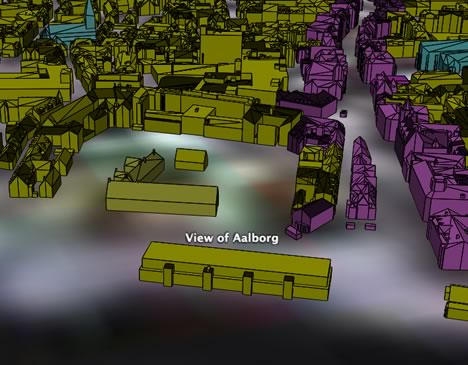
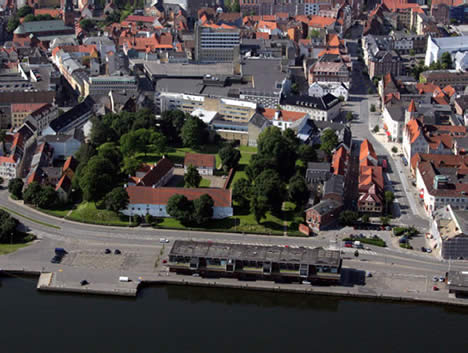
While the 3D model isn’t textured, it carries more detail than Google Earth’s default building layer. In fact, Aalborg seems to make most of their GIS resources freely available online. Obviously there is somebody enlightened working in Aalborg’s GIS department. Imagine if all cities did this.
Dept. of useless geography questions
Not long ago, a friend asked me what percentage of the world’s population I thought lived North of Stockholm. Off the top of my head, I guessed 1%. Obviously, he already knew the answer, having figured it out earlier (he’s like that) and it turns out only around 20 million people live at a higher latitude north than Stockholm, or one third of one percent of the world’s population.
Just yesterday, I sat wondering about what spot would have the most ocean surrounding it on its hemisphere, and also what spot would have the most land surrounding it. I fired up Google Earth and had a guess. Most ocean: Somewhere in the South Pacific, not surprisingly. Most land: Could it really be Stockholm?
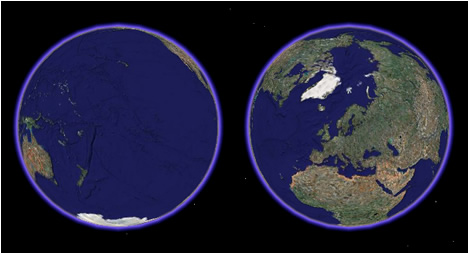
But surely GIS pros have datasets on which they could run analysis that would confirm such spots? Also, has anyone run analysis on the Gridded Population of the World database to determine what would be the best spot for a cataclysmic meteor to hit Earth, in terms of minimizing mass death? (I’m assuming perhaps naively that not being in the same hemisphere as ground zero makes you safe.) My guess is that the “best” site would be somewhere on Antarctica. As luck would have it, that is exactly where the world’s largest known meteorite crater lies buried.