Street View and privacy – what’s up with the Europeans?

What is it about Europeans that makes them so susceptible to populist arguments in favor of expectations of privacy in a public space? Sure, Google does not have the legal right to drive on private roads and photograph from there, as it appears to have done on two documented occasions in the US. That is a clear-cut case. In Europe, however, Street View is getting a steady onslaught of negative publicity, mainly instigated by populist newspapers, about the evils of taking photography in a public place and publishing it.

British tabloids are the worst offenders when it comes to tendentious reporting. For example, This is London‘s article is titled “Big Brother: The Google cars that will photograph EVERY front door in Britain“, and contains the ridiculous

Critics say the site can be used by burglars planning escape routes from homes and by terrorists looking for military bases. The site has even been used by teenagers arranging unauthorised swimming parties in unoccupied homes.

I love the “even”, as if terrorism is bad enough, but unauthorised swimming parties are beyond the pale.

The Liverpool Daily Post titled its article “Google Street View comes to Liverpool amid privacy fears” though without finding any civilians expressing said fears. The Mail on Sunday, today: Google ‘burglar’s charter’ street cameras given the all clear by privacy watchdog The BBC has a proper neutral take: Google Street View gets go ahead.

(None of the tabloids, of course, have picked up on the irony that their paparazzi constantly flout the privacy of their “marks” out in the public space, pictures of which they then sell to an eager readership now being urged to defend its right to privacy.)

German media too is hunting for privacy officials that are complaining, even if, as Bloomberg reports, “federal and state data-protection agents have yet to find a legal basis to hinder filming that’s carried out by cameras mounted on vehicles.”

“From a privacy viewpoint, we don’t welcome this activity,” Federal Commission spokesman Dietmar Mueller said in an interview today. “Yet we have no legal instance to challenge it — anyone can walk along a street with a camera.”

What a strange concept: Government officials complaining that a company is observing the law, but that they don’t like it anyway.

The right to privacy of an individual is not a absolute right — as by necessity it constrains the freedom of other individuals to document and record their surroundings. As a sometime photographer and journalist myself, I believe there should not be any expectations of privacy in public places (as opposed to private spaces and inside homes, though not in front of windows visible from public spaces). If you’re going to Disney World on a sick day or to a sleazy club instead of bowling, and I or Google accidentally take a snapshot of you and post it to Flickr or Street View, then that should be the end of it. The truth is out there — why smudge it?

Mapped and bombed – Tamil rebel training camp?

On July 30, the Sri Lankan air force bombed what they allege is a Tamil Tiger training camp, and released the video. Bloggers (and the local media) have been quick to locate the spot on Google Earth, where you can see high resolution imagery taken from 2003, before structures on the location were built.

Here is the Google Map of the place:


View Larger Map

Here is a still from the military-supplied video. Click to see the YouTube video:

srilanka1.jpg

I went looking at Microsoft’s and Yahoo’s imagery to see if they might have more recent hi-res imagery, but both maxed out at 15 meters per pixel. It’s in places like these, not in cities, where I get impressed when there is sub-meter resolution, even if it’s from 2003. This is one more reason why globally Google Earth and Map’s uptake is so much higher than the competition.

Virtual globes in Second Life

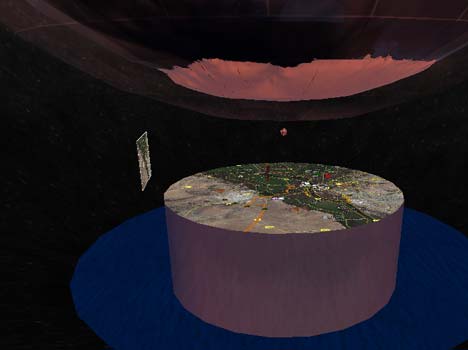
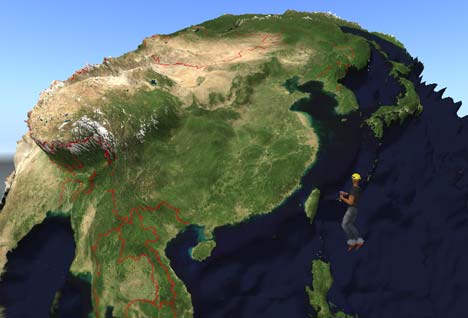
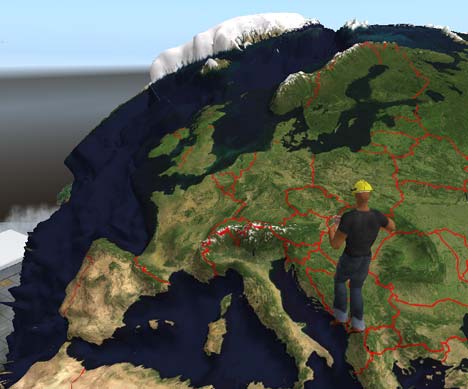
It occurred to me just the other day that NOAA’s Eric Hackathorn, whom I had met last year at ISDE5, had then said that he was thinking of making a programmable virtual globe in Second Life. I fired off an email to him wondering if he’d ever followed up on that idea. Sure enough, he writes that late last year he and his game-developer wife (SL name) Zora Spoonhammer created “Sculpty Earth” which was then extensively reviewed by Wagner James Au in New World Notes. YouTube excerpt:

A clever piece of hacking projects a movie of recent global cloud map images onto a transparent array floating above the Earth, letting you follow cloud patterns.

SL001.jpg

SL002.jpg

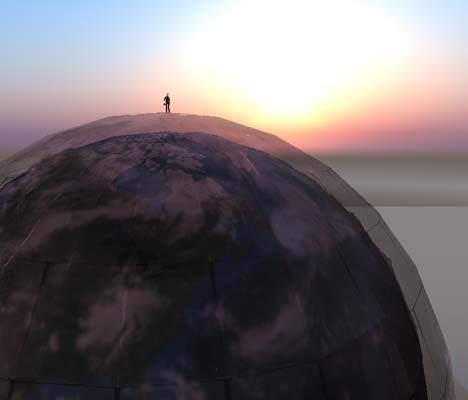
Very Caspar David Friedrich of me, no?

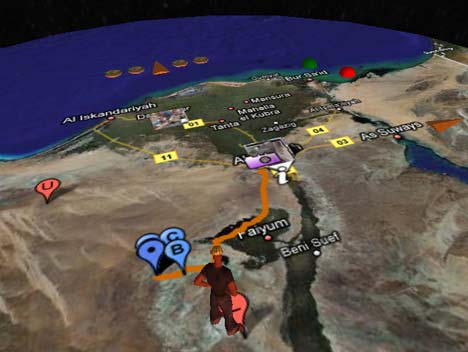
But that wasn’t the end of the project. In the last few months the duo have created two more Earths, both works in progress. Below one of them you’ll find a Google Maps application projected onto a plane that lets you load KML files, and which is controlled by nearby buttons. I managed to load some of my own KML content, and navigate around, albeit clumsily.

SL003.jpg

SL004.jpg

SL005.jpg

And while you also can’t click on the map to navigate or interact with the KML, the important point to take home from this proof of concept is that visitors are engaging in social cartography — anything that my avatar pulls up, your avatar can see too in real time. SL developers Daden Limited used similar technology in their Second Life Google Maps, blogged here a few months ago.

The map also lets you get a geosearch going:

SL006.jpg

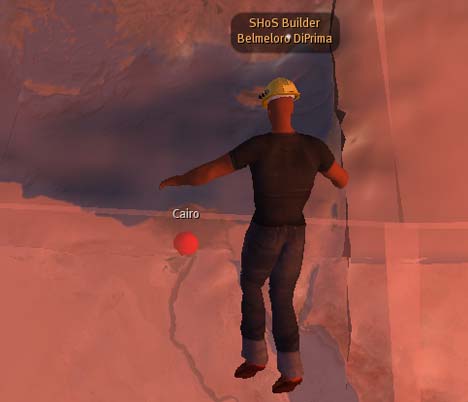
Sure enough, when I went looking on the virtual globe:

SL007.jpg

There are far more efficient ways of finding Cairo, of course, but that’s not the point — these are the first steps in radically new ways of navigating information.

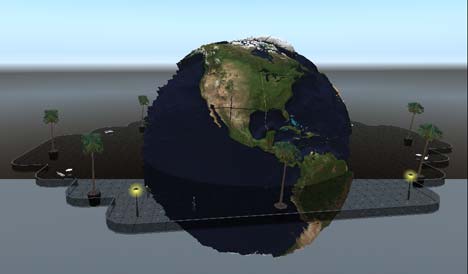
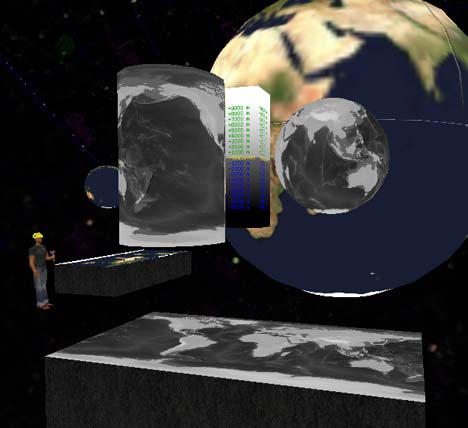
Independently, I got an email from Magnus Zeisig where he writes that the interest in his recently reviewed Second Life map of Sweden had compelled him to experiment with making an entire virtual globe in Second Life. He’d also just found Eric and Zora’s Earth — his in comparison is smaller, but with vertical heights exaggerated 100-fold and with accurate bathymetry. And if you walk into the Earth’s center, you’ll see an exhibition he is building about different map projections.

SL008.jpg

SL009.jpg

SL010.jpg

SL011.jpg

All these Earths aren’t nearly as smooth as dedicated virtual globe applications, or even browser-based virtual globes. That’s because Second Life is a general-purpose 3D programmable environment — so you lose speed, but get versatility. And these Second Life globes are social — visitors share the same world-state — which in turn opens up interesting possibilities for teaching and science outreach to classrooms. It’s early days yet — and in the meantime, these virtual virtual globes can hold their own purely as works of art that play with our notions of scale and space.

Links: levelHead; whither PhotoSynth? Multitouch sphere coming

  • Thinking inside the box: Not immediately geospatial, but certainly spatial: Behold the awesome levelHead game, by New Zealand’s Julian Oliver:


    levelHead v1.0, 3 cube speed-run (spoiler!) from Julian Oliver on Vimeo.

    (Via 3 Quarks Daily)

  • Photosynth to Virtual Earth? Yesterday, we all read the post by Microsoft’s Chris Pendleton that Microsoft’s Photosynth photo geopositioning Live Labs research project had graduated to the Virtual Earth team, the implication being that we would soon see this “productized” inside Virtual Earth.

    But by this morning, the link to the post went dead, and there is no more trace of the news in Chris’s archives. False alarm? Premature anouncement? Was it meant to be a secret?

    Pity, as I was going to build a post around it about how it really is high time that Microsoft expends more resources on making its web services truly standards-based, i.e. platform neutral. Google Earth’s 3D web plugin is just a few months old and is only a month away from getting a Mac version. Virtual Earth 3D has been out for over a year and a half and still has no cross-platform support. Photosynth, should it be heading for mainstream browser support, really also needs to work on the Mac.

    The reason is simple: Developers don’t want to use APIs to build consumer-oriented web services until the results work in a browser irrespective of operating system. Once Mac support arrives for the Google Earth plugin, that’s when its API will enter mainstream use by developers. Microsoft’s geoweb apps are ignoring the Mac minority, which is why they get comparatively less traction.

  • Multi-touch spherical display coming: Microsoft will be displaying one at a booth at the Microsoft Research Faculty Summit 2008 to be held this week, according to the floor plan. Mary-Jo Foley at ZDNet has more info: It is a multitouch sphere made by Global Imagination, one of a small group of spherical display manufacturers. For a recent overview of spherical displays, check out this Ogle Earth entry from a few months ago.

[Update 14:48 GMT: The YouTube demo is up!:]

400 million Google Earth users. Really?

In his Geoweb 2008 keynote speech, Michael Jones mentioned that among the 1 billion online, there are “400 million Google Earth users”, and that this “constituency” is bigger than the number of Americans.

Time for a reality check. That number for “Google Earth users” can’t be unique users. Downloads, sure, but not users. Just think about it: Let’s even allow 1.4 billion online people in 2008; less than a quarter of them have access to broadband, according to Gartner. And among broadband users, businesses are over-represented — businesses where a program like Google Earth is less likely to be downloaded. To get to the total of 400 million users, every computer on the planet connected to broadband would have to have Google Earth installed, plus a whole lot of people sucking Earth through a 56kbps straw.

Whence the discrepancy? I’ve done my part, downloading Google Earth at least a few dozen times between different versions and successive machines from all sorts of different IP addresses. And likely so have you. This is not to take anything away from the fantastic uptake of Google Earth, not least in the zeitgeist of the world’s technology elites; but just as websites no longer advertise the number of “hits” on their site, isn’t it time for a more conservative number on Google Earth users? Surely Google Earth can concoct a unique hash number for each install so that Google can acquire data for unique visitors per month, just like top websites do? Why not then release that if advertising the popularity of Google Earth is important?

Links: Flight path KML, Avi to Microsoft, future location

  • Flight path KML: Brian Mayer found Google Earth’s flight simulator’s learning curve steep, “so I decided to create a set of runway outlines and flight paths to serve as guides for getting from Point A to Point B.” The result is a KML package of 239 runways in 94 cities with 24 flight paths between them. I took it for a spin, and sure enough, I managed to land without crashing for the first time ever.
  • Avi Bar-Zeev to Microsoft: Keyhole co-founder Avi Bar-Zeev writes on his blog that he has just joined Microsoft. Avi left Keyhole in 2001 — Keyhole was acquired by Google in 2004 and its Earth product became Google Earth in 2005. What will he be working on?

    As to what I’ll be working on, keep in mind, my new supervisor actually found me and recruited me via this blog. That might help you make some guesses as to what we’re interested in.

    And on his blog, he’s been writing perceptive posts about the 3D internet lately:-)

  • Thinking about future location: I ended up watching Peter Batty’s entire presentation at GeoWeb on “Future Location and Social Networking“. I hadn’t planned to, but I was surprised to find a lot more deep thinking than I imagined was possible about this market segment. Peter’s put a lot of his thoughts into action with whereyougonnabe, a FaceBook application that competes with Dopplr. At the end of the video, there are some cool Google Earth visualizations.
  • Improvements in Google Maps ads: Valery Hronusov forwarded this, in case not all Google Maps developers had seen it. The Google Maps API now has much improved handling of Google ads, so you might want to go revisit your code.
  • EarthBrowser presentation: Matt Giger of EarthBrowser presents a Google Tech talk about his virtual globe, in which he also makes the case for a better representation of time in KML. In a separate post, he looks forward to Flash 10, as it would give him the ability to add 3D terrain to EarthBrowser.

Links: Microsoft frees trueSpace, novel map use, British Columbia frees geodata

  • Microsoft frees trueSpace 3D authoring tool: Microsoft’s Chris Pendleton over on his blog announces that trueSpace 7.6 — the $595 3D authoring tool by the recently acquired Caligari — is now free for all to download (Windows only), putting it smack in the same competitive space as Google SketchUp, with a similar ability to create 3D models and then position them on a virtual globe, in this case Virtual Earth. Chris’s post is detailed, and he implies that trueSpace is a much more advanced tool than SketchUp. (I haven’t had a chance to compare.)

    Not sure where this leaves Dassault Systemes 3DVIA, which Microsoft integrated into Virtual Earth as a kind of browser-based 3D authoring competitor to SketchUp. Ironically, it turns out that while Google’s been working on a browser-based version of its stand-alone virtual globe, Microsoft’s been working on acquiring a standalone replacement for its browser-based 3D authoring tool:-)

  • Novel map use: Clyde Ford writes:

    Thought you might be interested in my new geo-mashup that integrates VE and GE, switching between the two for the best satellite imagery. I’m a long-time software developer, but also a thriller writer, who wanted to design a site that allows readers to fly-to places in my book and once there to enjoy multimedia experiences. Hang out on the site long enough and you’ll hear Morgan Freeman’s voice talking about Precious Cargo, my latest book.

    It’s Windows only for now. For a book that name-checks a lot of locations (as a nautical novel is wont to do), this is certainly an interesting way of making places come alive.

  • British Columbia geodata in Google Earth: The Map Room finally made me look. Here is a belated link to guided tours of some lovely geospatial data of British Columbia in Google Earth.