Google acquires Jaiku, goes mobile presence

Wow number two of the day: Google has acquired Jaiku, the European Twitter, an “activity stream and presence sharing service” for mobile phones and the web, all very location-aware if you want it to be.

Congrats to Jaiku’s founders, especially Finland’s Jyri Engeström, whom we had speak at Bloggforum back in 2005 (see pics). Even then he was already propounding the idea of social networks not being any good if they aren’t about something we can have in common, things which he called “objects of sociality”. Later, Facebook’s popularity would ride on that notion — I now spend most of my time on Facebook playing Scrabble with friends; others spend hours comparing movie tastes with each other.

Facebook’s mobile client for my phone is not unlike Twitter’s and Jaiku’s. This, I think, is the space Google wants to enter by acquiring Jaiku. If and when Google comes out with a more open version of a Facebook-like “presence-centric” web application, Jaiku will make the perfect mobile component of that.

Meanwhile, I’m looking forward to the Google Earth layer that updates in real time, showing the locations of my friends and their most recent one-line message. (Thanks Daniel for the heads-up)

CNET: Google goes Multiverse

Well, wow.

screenshotmulti.jpg

CNET has the scoop on partnership between Multiverse Network and Google to be announced later today that will let you drop Google’s 3D Warehouse models into your own 3D virtual world that you can then walk around in with avatars. You can even drop in terrain from Google Earth.

All the info is in the CNET article, so do read it first. Some observations:

  • What Multiverse Networks has been developing is middleware, a virtual world 3D engine that developers can customize to create their own worlds for end users. Their Multiverse product has been seen as a potential competitor to Second Life because each of these different worlds created by different developers can be visited by the same 3D client. Now it appears that with content from Google Earth, the developers or even end users will be able create their own virtual worlds with elements from the real world.
  • The main reason usually given for why there hasn’t been a good software-based importer of 3D models into Second Life is that it is very difficult to do so while minimizing the total number of prims used for the version inside Second Life. Prims are the basic building blocks of all content in Second Life, and there is a limit to how many can fit on a “sim”, or island. There is also a limit to how many avatars can be on a single Second Life sim/server before it bogs down — 50 is a good number; much above it, and a sim becomes slow as molasses.

    Multiverse Networks would have had to solve this scaling problem for imported 3D content, and if the article is to be believed, it would appear to have done so:

    Multiverse’s technology has reached the point where it can support as many as 1,000 users per server, meaning any virtual world built using its platform and incorporating the Google Earth and 3D Warehouse models could see hundreds or even thousands of users running around inside it.

  • According to the article, this is not Google’s mooted play for a 3D open-standard social application to compete with Facebook and/or Second Life. What’s looking more plausible, suddenly, is that the fevered speculation from just a few weeks ago regarding Google’s plans in the 3D space was actually based on the conflation of two separate projects. There is this partnership with Multiverse Network, and then presumably there is something like an open Facebook. Or not.
  • Good to see Jerry Paffendorf and Mark Wallace surface over at Wello Horld.

I can’t wait to see the details of the announcement later today. Will I be needing to make a virtual Stockholm soon?

Links: Gigapan public beta, ArcGIS Explorer timeline

gigapanwhite.jpg

  • Gigapan’s panorama tool for digital cameras is now in public beta, at a surprisinly cheap $279. Only 400 available this round; apply by October 19.
  • BBC News has a fascinating article about how indigenous people in the Congo basin are being given special GPS devices to map the locations special to them.
  • ArcGIS Explorer gets a Time Navigator. Powerful stuff that encompasses pretty much all the wish-list items for Google Earth’s timeline tool:If only it would do all that with KML…

Revoke the Kyl-Bingaman Amendment, already

Checkpoint Jerusalem has a longer excerpt of the Yedioth Ajronoth article (covered previously) lamenting the advent of expanded high-resolution coverage of Israel, Gaza and the West Bank in Google Earth. One further paragraph in that article needs correcting:

Locating sensitive strategic and security installations in Israel is a central goal for such countries as Iran and Syria. The ability of Arab states to collect information is fairly limited, mainly with regard to collecting military intelligence using sophisticated technology. Up until now these countries had to rely on superpowers or on commercial companies, which usually sold them low resolution images. This, incidentally, explains the great advantage Israel had against the enemy when it built its own independent ability to launch espionage satellites.

The imagery sold commercially to all comers by the French, the Russians, by DigitalGlobe and others has been at two-meter resolution for years. The only thing that’s changed is that the cost of acquiring it by the public has now gone to zero, thanks to Google — and money is one thing that Israel’s enemies haven’t lacked. Meanwhile, the intelligence services of some countries hostile to Israel have most certainly had access to much higher resolution satellite imagery, which is shared easily enough with militant extremists.

Until Google Earth came along, the only people without easy access to high resolution imagery of the world’s military installations were those who aren’t obsessed by them — average citizens. The national security establishments of the world may not like their newfound public nakedness, but that is not sufficient reason for them to claim that they should not be subject to the scrutiny of the public. Until recently, the world’s security and military institutions were only subject to each other’s scrutiny and to that of non-state actors with a grudge and access to funding. A public informed by satellite imagery is not an additional military threat — though it may pose a political challenge. And that would be a Good Thing ™, because militaries are necessary evils that may, without proper public scrutiny, outlive or outgrow their usefulness, like any bureaucracy.

When it comes to Israel, there is the additional issue of needing to justify the Kyl-Bingaman Amendment to the US National Defense Authorization Act for Fiscal Year 1997, which forbids US remote sensing operators from selling imagery of Israel at resolutions that are higher than what’s available commercially elsewhere in the world — currently 2 meters per pixel. No other country in the world enjoys such protection. What is it about the nuclear research complex at Dimona that makes it more worthy of censorship than Three Mile Island?

The justification is that Israel, a small nation surrounded by hostile neighbors, is an easy target for short-range missiles in a way that a mall or US military installation in Missouri is not — georeferenced satellite imagery provides idiot-proof access to the coordinates of targets inside Israel. But the problem with this line of arguing is that 2-meter resolution imagery is already accurate enough for such targeting. In fact, 15-meter resolution imagery is sufficient, because the missiles that these coordinates would be used for have an accuracy of less than 15 meters. If the resolution of this imagery were to increase from 2 meters to 50 centimeters, nothing new would be given away in terms of targeting information — everybody already knows the precise coordinates of the nuclear reactor in Dimona, for example.

What 50 centimeter resolution imagery of Israel would give away is the same kind of information that 50 centimeter resolution imagery all over the world gives away — and the immense public benefits that come from it. If US bases all over the world can be at 50 centimeter resolution in Google Earth without the US military hyperventilating, then the Kyl-Bingaman Amendment begins to look like an anachronism from the days when satellite imagery was still an expensive and exclusive proposition. Furthermore, the amendment’s continued use in the case of Israel reënforces the arguments of those critics who fault Israel for undue influence in US foreign policy, which makes it impossible for the US to play the honest broker in Middle East peace initiatives.

But the Kyl-Bingaman Amendment is also a threat to those who advocate public scrutiny of all the militaries of the world, because it provides a slippery slope towards arbitrary censorship of US remote sensing imagery. A fascinating paper by Michael R. Hoversten from the Winter 2001 edition of the US Air Force Law Review, “U.S. national security and government regulation of commercial remote sensing from outer space“, delves deeply into the implications of the amendment. It’s worth excerpting at length (italics added for emphasis):

In 1996, the U.S. Congress passed a law as part of the National Defense Authorization Act for Fiscal Year 1997 restricting the collection and dissemination of imagery with respect to Israel. [127] Under this law, commonly referred to as the Kyl-Bingaman Amendment, private remote sensing operators may not be licensed to sell imagery regarding Israel unless the imagery to be sold is no more detailed or precise than that routinely available from other commercial sources. [128] “Pursuant to that law, the Department of [C]ommerce will make a finding as to the level of detail or precision of satellite imagery of Israel available from commercial sources.”[129] At a minimum, the Department of Commerce reviews non-U.S. commercially available imagery on an annual basis. Its findings will be in the Federal Register.[130] At present, the best resolution available from other commercial sources is approximately two meters. [131]

To obtain an operating license, private remote sensing operators must submit a plan explaining how its proposed system will comply with these restrictions. [132] Hence, while private companies such as Space Imaging Inc. are technically capable of producing imagery with better than one-meter resolution, they cannot sell such imagery regarding Israel. Beyond this, the President of the U.S. has the power under the law to designate other countries or geographic areas as falling under the same policy. There are no restrictions or guidelines as to when or under what circumstances the President may make such designations. Presumably, the President would exercise his prerogative for national security or foreign policy reasons but the law places no such restrictions on any designation.

It seems unlikely that the U.S. will significantly back away from its Open Skies policy unless national and world security concerns dictate otherwise. However, the passage of the 1997 Defense Authorization Act opens the door to such a scenario. In 1996, imagery with one-meter resolution was not available on the commercial market. With the currently available high-resolution imagery, it is likely that countries are much more concerned about the dissemination of commercial imagery today than they were four years ago. The problem the U.S. may soon have to contend with is States other than Israel demanding equal treatment. This could pose competitive problems for the U.S. commercial remote sensing industry as well as foreign relations problems for the U.S. Government. In the near future, the U.S. may well be faced with the choice of either abolishing the policy regarding Israel or extending the policy to other States.

Boy am I sure that the Indian government is happy I found that passage for them. If you are at all interested in such matters, there is much more elsewhere in the article — for example, Hoversten predicts that:

Due to the increasing availability of commercial imagery, the international community may conclude that to protect both national and world security interests, the creation of some type international shutter control is in order.

And that is precisely what India has been agitating for. An Indian official now at the UN made that argument explicitly back in 2006, when it was blogged here.

The best thing that can happen is for the US government to unambiguously recommit to its “Open Skies” policy for commercial satellite imagery and support increased global transparency for the simple reason that it is a boon for democracy movements and governmental accountability everywhere. Revoke the Kyl-Bingaman Amendment, already.


Flash in Google Earth: Geochat, but with a caveat.

When Google introduced support for flash-based video such as YouTube in Google Earth 4.2 beta for Windows, hackers soon found that any flash application can run, not just YouTube. Soon after, Mickey Mellen built GE Boards, a Flash-based geo-bulletin board for Google Earth, using Flash to submit forms to a server via Google Earth. (Google Earth’s HTML support does not include support for forms.)

Now Valery Hronusov, in yet another bout of envelope-pushing, has embedded a Flash-based Meebo chatroom into a placemark popup on Google Earth, effectively allowing georeferenced chats, or if you will, a virtual walk-in “office”. It works great, if you have Google Earth for Windows.

And there’s the rub, because a Windows-only extension of Google Earth’s functionality breaks the platform independence of the experience. There are two possible solutions for this:

  • Flash support in Google Earth goes universal. I’m sure this will eventually happen, though I’ve been told it will take a while.
  • Google Earth’s HTML inside placemark popups expands to include forms, and ideally a lot more, so that content inside such a popup can really just become an HTML browser window with the same feature set as, say, the cross-platform Firefox.

The latter is really the preferred option. In my biased opinion Flash applications as a rule are a waste of programming, though there are a couple of exceptions — embedded content like video via YouTube, Meebo chatrooms and the highly usable Google Street View in Google Maps.

Come to think of it, why hasn’t Street View been incorporated into Google Earth for Windows yet? Perhaps because feature parity between different platforms for a given version of Google Earth is important to the Google Earth team, in which case I’d agree. The more Google Earth feels like a platform-independent geobrowser, the better.

Besides Flash support, there are still a few other differences between the Windows and Mac versions of Google Earth (sorry, I can’t speak for Linux users): The Windows version has a built-in browser, full-screen mode and a more feature-rich API. This is the legacy of porting over an application that was first built just for the Windows platform before remaking the GUI in the cross-platform Qt.

Security through obscurity? Not post-Google Earth

The most recent imagery update is somewhat special in that many of the updated tiles are from DigitalGlobe imagery taken earlier this year. That’s a faster turn-around rate than we’ve seen, previously.

Do this: In the Layers pane, open the DigitalGlobe Coverage directory. Open the “DG Coverage – 2007” directory. Now turn on the layer for cloud cover 0-10%. This is the category that a lot of the new imagery belongs to. By surfing with this layer turned on, you can see where tiles correspond to the overlay. That’s where most of the newest imagery is.

If you do this, you can see how the Federation of American Scientists found a second Jin-Class submarine docked in a Chinese port, blogged on their Strategic Security Blog. That’s on an image taken on May 3, 2007.

Focusing on the middle east, notice that all of the Gaza Strip is now shown on imagery taken in June. As the tiles also contain Israeli imagery, they are artificially reduced in resolution to 2 meters per pixel, by US law for US satellite imaging companies. You can see pixellation artifacts in the resulting imagery.

Not that this is stopping some of the more alarmist voices in Israel from complaining, despite Israel being the only country in the world that can boast such blanket censorship. Editorial voices in the Israeli tabloid Yedioth Ahronot are apparently not happy, as quoted by Charles Levinson in Conflict Blotter:

[Yedioth Ahronot:] Sensitive installations, Air Force bases with their planes and helicopters, missile bases and even the nuclear reactor in Dimona have never been photographed better. A recent Google Earth update shows satellite pictures that make it possible to see clear, sharp pictures of military and civilian targets all across Israel.

Up until recently, the satellite pictures of Israel on Google Earth had a particularly low resolution: every pixel was equal to 10-20 meters. Now, the satellite maps of Israel show great parts of the country with a resolution close to two meters per pixel.

That’s not quite true. Large swathes of Israel have been visible at 2 meters per pixel since the summer of 2006. All that’s happened is that in some instances coverage has been updated, while in others it has been improved.

Meanwhile, some elements of the media in India are keen to find any support for their own jingoistic defense of censorship. India Daily has an article that explicitly makes the Israel-India analogy:

Google Earth uses civilian satellite imagery to portray the details on the earth. It is now easy to find the key Israeli and Indian nuclear reactors. It is also easy to find key military and air force bases.

The biggest question hover in the minds of Israelis and Indians — ‘Given the fact both the countries are surrounded by Islamic Jihadists and terrorists, should Google Earth not reveal secrets of these countries?’

Erm, yes it should? The Dimona imagery has been available on DigitalGlobe’s online store long before it hit Google Earth. Considering that Dimona and other places have been in public domain, and that those most determined to see the imagery have access to sources that are not Google Earth or even DigitalGlobe, I think it is a very good idea to democratize access to such information as much as we can — and Google is the leading light in this de facto campaign.

And to state the obvious, any army today that still believes in security through obscurity is in fact neither.

AEGIS: Exploring the Groth Strip in Google Sky

News today that a slew of data from AEGIS has made it into Google Sky. (Press release, good writeup on ScienceDaily)

What is AEGIS? It is the All-wavelength Extended Groth strip International Survey. What is the Groth Strip, then? It’s a narrow band of sky on the edge of Ursa Major and Bootes that’s absolutely crawling with galaxies, and which astronomers have decided to subject to the scrutiny of just about every instrument in their arsenal — visible light imagery comes from the Hubble Space Telescope (which is already in Google Sky’s base layer), ultraviolet light is courtesy of NASA’s Galaxy Evolution Explorer (GALEX) satellite, infrared we get from the Infrared Array Camera on NASA’s Spitzer Space Telescope, and x-ray imagery is from NASA’s Chandra X-ray Observatory. The latter three are visible as overlays whose opacity you can control to check what kind of an impression objects leave at different wavelengths.

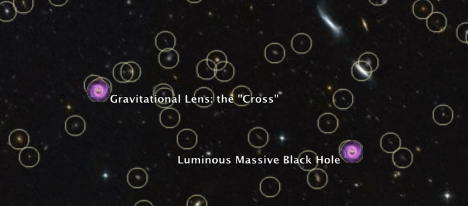
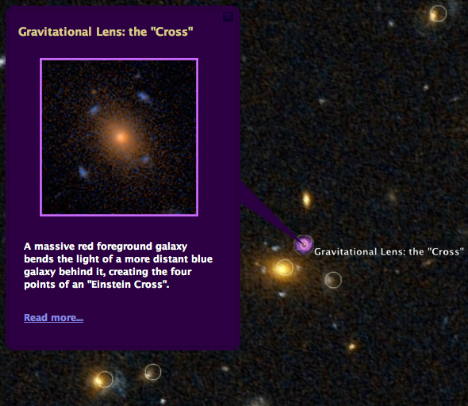
Many extragalactic objects in the region are also catalogued, and linked to the DEEP2 Galaxy Redshift database. Some objects get a special shout out. Look, real gravitational lenses!

grav3.jpg

grav2.jpg

grav.jpg

Here’s the AEGIS layer, which is linked to from this page in the Google Earth Gallery. AEGIS also has a more detailed explanation page and instructions. This is Google Sky doing what it was designed to do.