Chris DiBona: Accessible high-resolution Earth a cause for optimism

Thanks to Teacher’s Lounge blog for flagging this: In response to 2007’s Edge Annual Question thrown out to some of the world’s leading thinkers, “What are you optimistic about?”, Google’s Chris Dibona shows he totally groks the ongoing democratization of access to high resolution imagery of the earth:

Widely Available, Constantly Renewing, High Resolution Images of the Earth Will End Conflict and Ecological Devastation As We Know It

I am not so much of a fool to think that war will end, no matter how much I wish that our shared future could include such a thing. Nor do I think that people will stop the careless destruction of flora and fauna for personal, corporate, national or international gain. I do believe that the advent of rapidly updating, citizenry-available high resolution imagery will remove the protection of the veil of ignorance and secrecy from the powerful and exploitative among us.

Read the whole thing.

Links: Geographic web FAQ: Garmin does dog tracking

Licensing impasse holds up virtual London

I’m back in Cambridge for the weekend, getting IPY.org out the door. In the meantime, here’s some commentary on my airport reading:

Andrew Hudson-Smith points to an article/op-ed piece in the Guardian (where he is quoted) that laments the copyright squabbles that are keeping a 3D building layer of London out of Google Earth:

Google was equally enthusiastic and approached the university about incorporating Virtual London into its city maps.

At the moment, London boroughs can use Virtual London under licences they have with Ordnance Survey [OS] and Infoterra, which supplied the Lidar data. What nobody can do is put the model on the web for all to see. Google’s approach “led to some discussion between OS and Google”.

However, these discussions appear to have reached an impasse. The sticking point is understood to be Google’s attempt to negotiate a fixed fee for the data, rather than accepting Ordnance Survey’s practice of charging by the number of transactions. Ordnance Survey would not comment on the specific case, but said that a fixed fee would “wreck the level playing field for other partners” – and it should be noted that it is obliged to treat all customers (including itself) on the same terms. OS said it is happy for its data to be used in a “Google-type” environment. “Sites such as Multimap and Streetmap use our data and their services are freely available to the public over the web.”

[…]The impasse illustrates the difficulty faced by Ordnance Survey in adapting its licensing policies for the new age.

When GIS was a specialized field, pay per use wouldn’t bankrupt anyone, nor make anyone rich. But when the number of potential users for this data reaches the hundreds of millions, then it really is time to come up with another model for rewarding innovation, especially when the cost of duplicating content asymptotically approaches zero. In other words, OS’s other partners are also being overcharged, now that the data in question is ready for mainstream consumption.

Interestingly, (I know, I’m using that word too much of late) the article is part of a wider campaign by the Guardian to make tax-payer funded data free to all. But Google wasn’t even asking for free data — it just wanted a licensing model that can scale with the rising popularity of geobrowsers.

Contrast all this with a recent more successful model for collaboration: NASA giving its raw data away in return for help from Google in processing it and serving it. Perhaps the Ordinance Survey and Google could try out something more creative along those lines — could OS use some time or room on Google’s server farms for some projects, perhaps? Surely some Google technology would be of use to OS in some kind of barter deal?

(Malicious afterthought: There must be a fixed cost to getting this data for oneself, without OS’s help. Perhaps Google could collaborate with open-source initiatives like OpenStreetMap to obtain a duplicate set, and then there would be no need to for anyone to license this data from OS anymore. This prospect in turn might drive OS to make a fixed-cost deal.)
Short News: Army uses for Google Earth, FON wifi locations

  • Military site Strategy Page looks at the effect Google Earth had in 2006… among US troops:

    Google Earth’s major problem was not it’s ease-of-use, but the manner in which it showcased the shortcomings of the American NGA (National Geospatial Intelligence Agency). The NGA is responsible for taking the satellite photos, spiffing them up as needed, and getting them to the troops. Trouble is, the stuff still isn’t getting to the troops that need it, when they need it. This was made very obvious when Google Earth showed up, and demonstrated how you can get satellite images to anyone, when they need it, with minimal hassle.

    That was the case too for when disaster strikes — such as with Katrina and the quake in Pakistan during 2005.

  • An image of a brave new world that makes me very happy. It’s easy to be optimistic about the future when stuff like this is happening.
  • You may have heard of FON, a grassroots wifi network of Spanish origin that is Big in Japan. There is now a Google Maps mashup that shows you where the FON wifi hotspots are, and it comes with a KML link. (Via Going My Way, whose author is definitely an early adopter)
  • There’s a new Japanese Google Earth fan site on my radar screen: Noblesse Oblige. It comes with its own blog and wiki. I don’t understand much of it, but it looks promising:-)
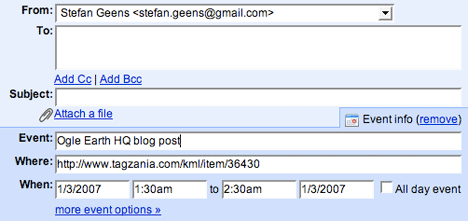
  • Tip of the week from Valery:-) In Gmail, if you compose a new email message, you can add event info, and there, too, you can add KML files in the “Where” field:

gmailevent.gif

Geonomy

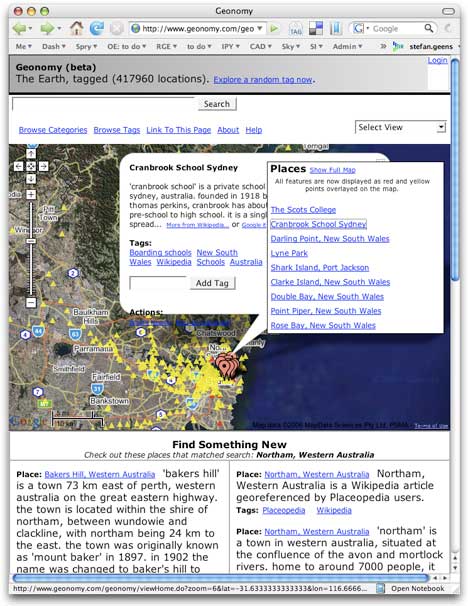
There is a new geotagging site on the block. Right from the get-go, Geonomy sports over 400,000 georeferenced locations — wikipedia articles, National Geospatial Intelligence Agency data, user-added content, geographic features — all of it searchable, viewable in Google Maps, and browsable by category and tag. Add to this USGS topo maps and US weather as overlays in Google maps. The pièce de resistance, however: Each category and tag has its own KML link for instant viewing in Google Earth. I just wish they’d be dynamic network links.

geonomy.jpg

The site is the work of Ben Lewis and Scott Melby. Here’s how they explain what they’re doing:

Geonomy does not aim to be a warehouse of map information but rather an index to place descriptions which already exist on the web. Geonomy does aim to help expand the list of existing descriptions, improve the geographic locations of existing features, and to help improvements make it back into Wikipedia and other repositories.

That makes Geonomy more like Wikimapia and Geonames.org than Tagzania. One thing is for sure: The bestiary of georeferencing sites sure has grown this past year to contain some very varied specimens.

If you’re curious for more, Scott Melby is interviewed about Geonomy over on Profy. Interestingly, Scott also runs a wine blognow georeferenced, of course. (Via The Blog Herald)

Ford and Microsoft to put Virtual Earth in the car?

Last Friday, the WSJ reported that Microsoft and Ford are set to announce Sync at the Detroit auto show and the Consumer Electronics Show in Las Vegas in the second week of January.

What is Sync? The WSJ calls it

A hands-free Bluetooth wireless system and in-vehicle operating system developed by Microsoft that will eventually be an option for its entire Ford brand lineup, according to people familiar with the matter.

The WSJ sees this as a necessary move for Microsoft to combat the lead Apple has with its in-car iPod connectors. But there is another motive for Microsoft to invade the car cockpit — one that’s just as good, if not better than a defensive move in the iPod stakes:

Localized search with in-car navigation.

Google and Volkswagen announced their collaboration on a navigation system based on Google Earth at last year’s Consumer Electronics Show, and had something to show for it by March, though it continues to be in development. (Some enthusiasts couldn’t wait and made their own.)

Microsoft finds it imperative to have a presence in cars, to keep both Apple and Google in check. But it’s not clear yet just how extensive the navigation functionality of Sync will be — the WSJ says only that “In many cases, the technology will be integrated into a navigation system.”

What is clear, however, is that if Microsoft comes up with something next week that does not in any way leverage its Virtual Earth 3D and/or Live Local capabilities, then it will have dropped the ball. Google Earth and Virtual Earth are like TomToms on steroids, and there is evidently strong demand for in-car navigation of this sort. Putting the map where most people use it (in the car) is obviously a good idea.