And then there were two (KML editors)

This time last week, no KML editors in English. Today, there are two:

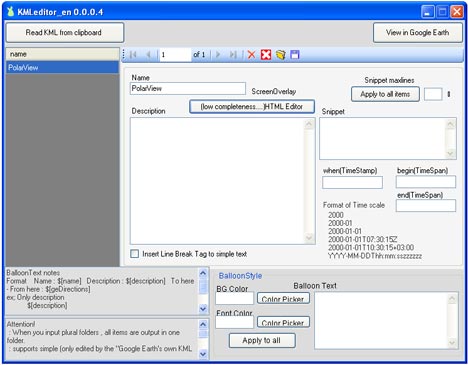
KMLEditor, the Japanese language editor profiled a few days ago, now has English localization. Download it here.

KMLEditor_en.jpg

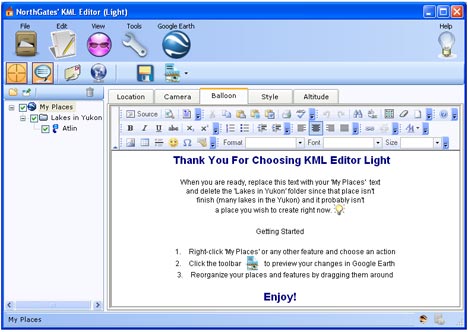
NorthGates’ KML Editor is a brand new entry, which you can download here.

northgates.jpg

Check out both. KMLEditor seems to have more features — for example, support for time — but it is early days yet. Anyone up for making a Mac version? (Via comments)

Ice Ice, baby

Last week saw the launch of International Polar Year, a global effort by thousands of scientists from around 60 countries to research the polar regions in a special coordinated effort. Planning has been ongoing for years, but as luck would have it, concerns about global warming have hit the limelight just as IPY gets going — and the polar regions are the canary in the coalmine of climate change.

Last week, too saw a number of new KML offerings focusing on the poles and on ice-covered regions — the cryosphere. First up is the wholly revamped page listing the KML files of the National Snow and Ice Data Center. Go there to find historical sea ice extents, glaciers with then-and-now photos, permafrost extents, and georeferenced images of Antarctica.

EarthSLOT’s Matt Nolan and a team have been working to put a lot more IPY resources on the map as a Google Earth layer. The result is this KML file, still in beta, and with plenty more stuff to come. As it stands now, the file contains a great georeferenced introduction to IPY, as well as a country-sorted georeferenced list of all IPY-endorsed scientific projects. Expect it to grow too during the next two years, as the results of IPY endorsed projects start to become available.

Finally, to mark the launch of IPY on March 1, the IPY team did something fun with Tagzania — schools from around the world were invited to conduct an ice-related experiment in class, and then launched a “virtual balloon” — which looks remarkably similar to a Google Maps marker:-) — which showed up on the site, and of course on Google Earth too:


IPY tagged map – Tagzania

This map is also the first to use a new feature for embedded maps, which allows you to place up to 200 most recent tagged placemarks — previously, the maximum was 25, but Tagzania’s Luistxo and co. saw this a great opportunity to introduce a new feature.

And all this just in the first week of IPY:-)

Links: Oz scaremongering, KML Editor (in Japanese)

  • I don’t believe it. Here we go again. The Melbourne Herald Sun tries the “Google Earth is a threat” tack, managing to get every fact in the next two paragraphs wrong;

    This contrasts with US authorities, which sought modification of images of the White House and other sensitive locations, leading to temporary shading blocks being placed to obscure some aspects of buildings.

    Britain also sought the blotting out of potential terrorist or military targets, including its Government Communications Headquarters, the Faslane nuclear submarine base, and the Fairford airfield used by U2 spy planes.

    (The only bit the UK government managed to erase was its bases in basra). Australia last featured on this blog in August 2005, when the head of Australia’s nuclear energy agency wanted to censor the imagery in Google Earth of that country’s only nuclear reactor, only to be overruled by cooler heads in the federal government. The imagery stayed as it added no danger.

  • If you speak Japanese and have a PC, KML Editor does precisely what its name suggests. I’m surprised nothing like this has come out in English — Google Earth’s own KML editing features are rudimentary, and do not let you access many of KML’s extended feature set, including its styling abilities. That would appear to be an obvious business opportunity.

0303_2.jpg

Links: KML => OGC? Berlin in 3D? Sky-map.org

I’m in Cairo and loving it, and just now firmly ensconced in a fast internet café on Zamalek island, catching up on events of the past week:

  • Metacarta press release announcing support for KML, February 26, 2007:

    For the first time, companies and governments can now search unstructured text documents for geographic locations and visualize these references on a map using Google Earth, ESRI ArcGIS Explorer or NASA World Wind interfaces.

    How is that different from the Metacarta press release announcing support for KML on May 15, 2006? That was for Google Earth Enterprise only. (The original post on Ogle Earth.)

  • Quirky but fascinating KML content of the month: White-tailed deer density in Connecticut. (Via GIS Planet, which has more info.)
  • Looks like the process of making KML an open format, managed by the Open Geospatial Consortium (OGC) is under way. All Points Blog points us at the discussion. I wonder if this means that the bulk of the rapid development we’ve seen have been made — previously, the Google Earth team has argued that opening the format would slow such innovation, and that it would make KML open once the torrid pace subsided.
  • Internetnews.com’s Nicholas Carlson talks to Google Earth Product Manager Peter Birch, and comes away with these interesting bits of info:
    • He too gets told there is no Second Life-like future for Google Earth. It’s all going to be about the real world.
    • We’re now talking 200 million downloads, (up from 100 million in June 2006 and near 0 in June 2005). That’s an increasing pace.
    • Google’s monetization strategy for Google Earth will involve selling priority placements in KML search results, in a manner analogous to Google Search.
  • More about Google Earth’s demographics on Pi: Quiet Musing, whose author was at at a presentation by the Google Earth team of Google Earth Enterprise.

    One astounding statistic quoted was the vast number of users GE has been able to accumulate over its short life- approximately 200 million; reportedly many more than those by Google Maps, with nearly 80% for casual uses. And a surprising number, or so we are told, falls in the 45+ age group.

    It would be interesting to know what the criteria for casual use are, and how the age group data was gathered.

  • If my German is not worse than I imagine it, then according to this article, Berlin is coming to a Google Earth near you in all its three-dimensional glory on March 8, brought to you by Berlin’s business promotion body, Berlin Partner. They may be the second city to announce this, but if Hamburg doesn’t hurry up, Berlin may soon be the first to go all 3D (if that is what we get — the article talks about using cadastral data, but without informing us if the resulting buildings will be textured.)
  • Only tangentially related, via comments, but awesome: Sky-map.org is exactly analogous to Google Maps, but for the night sky. I love the fact that you can get live coordinate data, a permalink to a specific view (!) and also that you can overlay the Sloan Digital Sky Survey (SDSS) over your view (!!). Here, for example, is a permalink to the SDSS view of M13, a massive globular cluster. How come I didn’t know about this before?:-)

Google Earth update makes Alps sparkle

I’m a relatively bad skier. That’s okay, I’ve only done it three times before in my life, so I can still pretend that I’m a fast learner, especially as I have friends who are very good skiers and who are glad to teach me. They also think it is hilarious to take me up steep slopes and then watch me tumble down them — as was the case with my ascent by cable car of the Mont Fort mountain (3,330m) near Verbier in Switzerland earlier this week, and the far less dignified descent on skis down a glacier. But at least you can appreciate the view when you’re on your ass in the snow.

All this as a prelude to the absolutely stunning imagery and terrain upgrade of Switzerland (and other places) that the Google Earth team rolled out on February 28. I had last checked up on Mont Fort in Google Earth what must have been hours before the update, and the difference is spectacular.
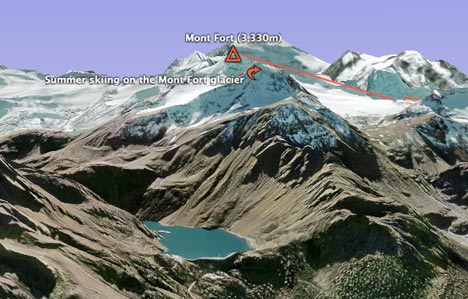
montfortandlake.jpg

The terrain (DEM) upgrade to a resolution of 10 meters for all of Switzerland is probably the most important single improvement. Now, mountain lakes and dams are rendered with pinpoint accuracy, and mountain slope imagery no longer suffers from misalignment with the DEM.

mountainlake.jpg

The terrain upgrade also makes Google Earth what must be the best tool anywhere for planning your skiing (in Switzerland). This is 3D terrain information that is actually usable, and ski resort operators would be crazy not to build a version of their ski slopes in Google Earth, where they show cable cars routes with actual buildings, annotated ski slope routes, off-piste suggestions and even avalanche-prone areas. And if you’re a GIS developer, you’d be crazy not to pitch this idea to them:-) especially as the intended users won’t be businesses and hence don’t need Google Earth Pro licenses to consume your work.

I had a quick go drawing the routes of the cable cars that take you from Verbier to Mont Fort, just as a proof of concept. As an added bonus, the new imagery shows an actual ski trail of somebody summer skiing on Mont Fort’s glacier. It’s not as scary as it looks. On my way down, I eventually came to rest near a Swedish mom commending her helmeted child on what a fine job he had done skiing down the glacier. I called out to my expert skiing buddy, “look, I’m being beaten by a 10-year old boy”, only to have me corrected by the mom, “actually, she’s a 6-year old girl.” That’s how the Swedes produce those Anja Pärsons.

I really wish I had taken my GPS device with me (Nokia N95, where are you?) but with standard DEMs, there really isn’t much point when trying to track your progress in mountains on Google Earth. Now (in Switzerland), GPS tracking and DEMs have similar accuracy, and that makes all the difference in a mountainous region.

<rant>As an aside, this kind of high resolution data — both imagery and terrain — is occasionally referred to cynically on NASA World Wind developer’s blog Bull’s rambles as being wonderful if all you want to do is look at your own house. I think that misses the point entirely (perhaps intentionally). Sub-meter imagery resolution makes available a whole new world of social information, because it is at this resolution that we can start seeing objects that we interact with in our daily lives. I think it’s the killer feature for geobrowsers, but there is also a more serious benefit, and this was shown during Katrina and the Pakistan quake, back in 2005. In these cases, seeing somebody’s house became a matter of life and death. In other cases, this kind of resolution can document human rights abuses. If I can also see my own house, that’s great. </rant>

Finally, here are the rest of the improvements, as noted on Google Earth Community:

  • Entire country of Switzerland at 50cm and many Swiss cities at 25cm (thank you, Endoxon)
  • Entire country of Switzerland terrain at 10m, the Swiss Alps are now high-res!
  • Entire country of Denmark at 50cm
  • Australia day flyover
  • Cities of France: Lyon; Le Mans; Lourdes; Reims; Nancy; Limoges; Lille; Arles
  • Potsdam and Magdeburg, Germany
  • Barcelona, Belem, CapeTown, Galapagos (Isabella Island), Manaus, Mt Saint Helens, Recife, Rio, Venice)
  • Whistler British Columbia
  • Full state coverage for Wyoming & Utah
  • significant amounts of new Digital Globe data

    Oh, I almost forgot. Gratuitous shot of a pixel-perfect Matterhorn:
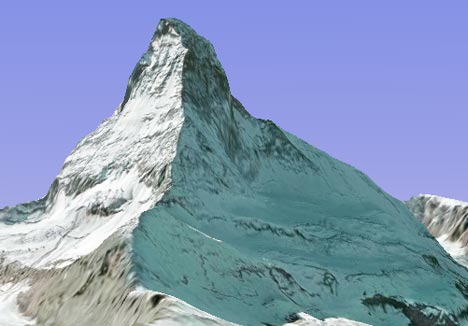
    matterhorn-new.jpg

    Links: Two new convergence examples

    Back from skiing, I’m still in one piece, tomorrow Cairo, but first:

    • Convergence example #1: Mura Aktihanoglu writes:

      I thought you might be interested in hearing about my project that turns Google Earth into a multi-user environment:

      www.unype.com

      It lets you connect to and follow another user in Google Earth. As the user moves, you move too, in real-time. Avatars, sharing models is coming soon. And, by the way, it is free, if you’d like to try it.

      For PC only, as unype digs deep into the Google Earth API. (Not tested — no time this week!)

    • Convergence example #2: Word Finder, Google Earth Edition. Adding a physical component to traditionally sedentary pursuits is a great idea. Just wait till all phones come with GPS — a mobile version of this could be a killer app. Find a meadow, a few players with phones, have one phone “project” a shared game board, and let the physical exercise begin.
    • Ed Parsons on the quiet revolution that is KML search in Google Earth (and soon Maps).
    • Wikimapia fulfills a similar function as Google Earth Community — it it allows you to describe places and regions collectively, on top of Google Maps. You can add comments anonymously, and many Indian students have taken this opportunity to rate academic institutions. Not everyone is happy, reports Times of India. Just wait until people start describing military institutions. In fact, I’m predicting that article for next week, followed by one where some government body calls for “measures” to be taken. The only problem: As far as I know, unlike Google, Wikimapia has no connection to India, so there’d be no business interests to threaten as leverage.
    • BrightGIS will build you a billboard in Google Earth, reports Marketing & Strategy Innovation Blog. Writes BrightGIS, “Promote your business to the millions of users of Google Earth!”

      Oh really? Doesn’t that sound like everyone who downloads Google Earth gets to see your signs? Except that they don’t. The billboards get uploaded to the 3D Warehouse, and these items are only available via the 3D Warehouse network link. Google Earth doesn’t show you that link by default; the application’s default layers will only show you the “best of 3D Warehouse”, and it is unlikely that advertising signs that don’t exist in real life will ever get promoted that high. In other words, a minuscule proportion of people will get to see these billboards — and the ones that do will have done so by loading the 3D network link, stumbling across the placemark, seeing that it’s for a billboard, and then clicking through to it to download it and render it. None of this gets explained to the potential clients on the website. In others words, this borders on false advertising.

    • The Inquirer reports: Buenos Aires province tax authorities are using Google Earth to catch tax dodgers, comparing building permits with actual imagery.
    • Oil firm BP has hired UK’s Tadpole to georefence all of BP’s sites globally and to make this information available internally via Google Earth, according to this press release:

      Utilizing the Google Earth user interface, the system will provide a digital world map displaying the exact location of all BP sites across the globe. Each BP site will be represented by a point on the map that links to a virtual filing cabinet, displaying up to date site-specific data and compliance documentation.

    Virtual Earth’s Curlander on Google Earth

    The Virtual Earth blog points to an interview in Geoplace.com with John Curlander, who was part of Vexcel, which was acquired by Microsoft for its photogrammetry technology and integrated into the Virtual Earth team. Curlander talks a lot about Virtual Earth’s business model, and it is interesting reading, but he does get some things wrong about Google Earth:

    GeoWorld: Would you say that your Web-services approach is different than how Google approaches the market?

    Curlander: Google Earth isn’t really a Web service. Google bought Keyhole a few years ago for its application that’s now called Google Earth. It’s basically a 3-D viewer Google Earth and Google Maps, their Web service, are completely separate. You have to go to Google Maps for the driving directions, yellow pages, etc. and Google Earth for the 3-D visual.

    Except that Google Earth really is a web service — or at the very least an internet service, with all its data streamed live to the client. Also, Google Earth and Google Maps share the same imagery dataset, and Google Maps can render a subset of Google Earth’s native KML file format. Finally, Google Earth does do driving directions and yellow pages, just like Google Maps. So Curlander should try the competition again sometime.

    Other than selling the pro version of the viewer, I don’t think they’ve been successful in connecting Google Earth into any sort of business model. Maybe in the future they’ll be able to bring these tools together, but they will have to rewrite Google Earth since it is a thick client application. One of the limitations of this thick-client application, of which they have released a number of versions, is that you have to download the whole thing each time.

    That said, you don’t have to download a new version of Google Earth to get access to new imagery dataset updates, new layers and new functionality like KML search. With Virtual Earth, meanwhile, you regularly have to update your browser and the plugin via the Windows updater. So the relative advantages are not that clear-cut.