Skyline/Google judgment: Dance != Dancer

Google Copyright Blog has a link to the summary judgment in the Skyline vs. Google patent dispute issued on March 7, below a history of the dispute and a overview of the decision.

The upshot: Skyline’s patent doesn’t describe how the Google Earth client receives data and renders it on the screen. The overall function of what Skyline’s and Google’s systems do may be similar, but that’s not what a patent covers. Here is the nut graph of the decision:

Skyline has not identified any “thing” that corresponds to the renderer as defined in the ‘189 patent. Skyline admits as much in its Corrected Memorandum in Support of Its Motion for Summary Judgment of Infringement, when it accuses Google of “quibbling that these three functions [of the renderer] are not performed by the same ‘logical entity’ or ‘object’.” The demand that a “renderer” be identifiable as a discrete entity of some sort is not a quibble, however; it is fundamental to a finding of infringement. The ‘189 patent describes a particular way of structuring a system for streaming three-dimensional data. Not any system that achieves the same result is covered. To succeed on its motion for summary judgment, Skyline must show that the accused Google Earth products infringe on the particular system described in the ‘189 patent. The “renderer” is at the core of that system. The failure to identify some thing that performs the functions of the renderer is fatal to Skyline’s motion for summary judgement on Claim 1.

A footnote is even clearer:

Skyline’s ultimate position, as presented at the summary judgment oral argument, appears to be that the Google Earth Client, a “software application, running on the local processor,” itself “performs the three renderer functions.” [Skyline Slide #29] However, Skyline also suggests that unspecified pieces of the Google Earth Client source code perform the functions of the renderer, suggesting a more granular definition. [Id.] In either formulation, the Skyline position, which I reject, erroneously conflates the functions of the renderer with the separate thing that is a renderer. This takes considerable and unwarranted poetic license with the Markman construction and, as I noted during the hearing on the motions, calls to mind Yeats’ question: “How can we know the dancer from the dance?” W. B. Yeats, Among School Children, THE COLLECTED POEMS OF W. B. YEATS, 215, 217 (Richard J. Finneran ed., rev. 2d ed. 1996).

Avi Bar-Ze’ev has a detailed dissection of the judgment, which he lauds (and which is well worth a read).
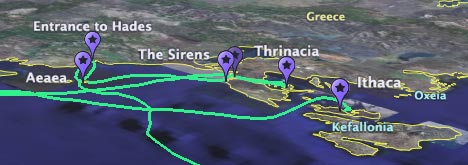
Links: GoogleLit Trips, Barry Hunter’s PHP class for KML, Itidarod

litrips.jpg

  • What literature lends itself especially well to georeferencing? Travel literature, of course. And there is no better travel literature than The Aeneid and The Oddysey. Both are available at GoogleLit Trips, a wonderfully single-minded website devoted to turning great works of literature into KML files. The author is Jerome Burg, a Google Certified Teacher. (If I may make a request: Herodotus)
  • Nearby.org.uk’s Barry Hunter writes a PHP abstraction class for KML and shares.
  • Erik Gregg and Matt Nolan have a live KML tracker of dogsled racers in the Itidarod across Alaska. Frank Taylor at Google Earth Blog has more.
  • More remarkable than the discovery of an out-of-date label for a German mountain in Google Earth is the extent to which the Reuters article that was written about it got picked up by scores of newspapers. The same conclusion must be reached yet again: People perceive Google’s toponyms as some kind of standard, their wide use molding opinion and hence something worth fighting over.
  • Microsoft tries to sensor its satellite imagery by asking the US government which bits exactly it would like blacked out, but gets rebuffed. Silly Microsoft.
  • A Turkish court blocked access to Google’s YouTube from within Turkey on Wednesday, as the IHT reports, because one of the user-submitted videos “insulted” Ataturk, which is a crime in Turkey. This is precisely the kind of stuff that will happen more and more as authoritarian laws of old meet the brave new world of user-generated content.

    I wonder, though, does Google need Turkish YouTube viewers more than Turkish viewers need YouTube? Google says it has now removed the video that “offended” Ataturk, which is not a promising sign. Would Google then also remove sensitive content posted to Google Earth Community, if Turkey were to ask?

  • ABCNews flags the fact that the blocking of Google Earth in Bahrain and Morocco (was the latter ever confirmed?) made it into the US State Department’s 2006 Annual Report on Human Rights. (Why can’t I do a text search that covers the entire report?)
  • Is it just me, or have the most recent new map-based applications seen more Virtual Earth-based solutions? Two datapoints: Superpages.com and Weather.com.
  • New niche blog on the block: Aidan’s Census KML Data Visualization. (Via comments)
  • That one Digital Globe image from 2004 that was yanked from Basra wasn’t the only one. This blogger documents how an Australian base near the Ziggurat of Ur has also disappeared, as imagery is reverted to pre-war views. Not surprising — and there are certainly more such spots in Iraq.
  • Slashdot reports on a new search engine for matching 3D shapes that is purportedly 1,500 times faster than previous attempts. I wonder if this will have implications for finding plagiarists in Second Life and 3D Warehouse:-)

3D Berlin arrives as a KML network link

As promised, Berlin is today available in 3D, as a downloadable network link. A pleasant surprise — a good portion of the buildings are textured!

berlin3d2.jpg

Of course there is a caveat: Everybody wants to check this out, so the servers are overloaded, and you will likely not get to actually see buildings for the next day. So, while waiting for the network link to work, enjoy some screenshots on the official site.

(Note: I am sure that the fact Berlin got this done before Hamburg has nothing to do with inter-city rivalry:-)

(Thanks to Frank via the comments)

[Update 15:31 UTC: The current implementation, bizarrely, is not Mac compatible.]

Vint Cerf: Censorship a “very slippery slope”

The Sydney Morning Herald has an Q&A with Google chief internet evangelist Vint Cerf in which he is asked about censorship. Long and interesting excerpt follows:

Is censoring something you would advocate?

I don’t think so and part of the reason is it’s very, very difficult to literally manage the content of the internet because it comes from literally everywhere.

The internet is designed to be a very technically open environment, so what I frankly believe has to happen is two things. First, deeper education so people understand the consequences of abuse; the second one may, in fact, be legal frameworks in which really antisocial behaviour can be dealt with.

A related issue to the question of Google’s responsibility for what goes up on its sites is the issue of security and privacy, which have cropped up with the launch of products like Google Earth and Google Maps. Has it been a surprise that you’ve taken some flak over these issues?

I don’t think we necessarily anticipated any of this and it’s partly because the information that is put up on, for example, Google Earth comes from public sources. We don’t have any special sources. We don’t fly satellites of our own. The information is available to the public.

In some cases it’s free and in some cases we have to pay for it, and we don’t alter anything. There was an exchange that took place in India [last month] and there was some confusion about that. So far as I’m aware, and I double-checked with the Google Earth team, we do not alter any of the images we get. So if there’s something obscure about them, that’s because it’s just the way they came.

Google does understand, though, that there are some consequences of having ready access to this kind of information, and we’re ready to sit down and talk with governments that might have some concerns.

It’s not as if we’re ignorant of the hazards. On the other hand, I would suggest that any time you seek censorship you introduce a very slippery slope because then it becomes a case of who decides what’s acceptable and what isn’t, and how far do you go in this and does it become political, and does it become religious, does it become mere opinion or ideology, and is that the kind of society that we want to live in?

That last paragraph is most eloquent. Well put, Vint.

Skyline patent infringement suit agains Google Earth dismissed

Yesterday evening local time, a judge at the US District Court of Massachusetts dismissed the patent infringement suit brought by Skyline Software Systems against Keyhole Inc. back in 2004. Google inherited this suit when it bought Keyhole later on in 2004. (Google Earth is the result of that purchase.)

There is one syndicated AP story out there about this, and it is a gem of concise reporting.

Implications? Not much, I think. When lawsuits demand an injunction against the use of a popular piece of technology, be it Google Earth or Blackberry, there is always a small risk of large consequences. That shadow has now been lifted for Google Earth. Just maybe, the dismissal of this suit is a prerequisite for further development or cooperation. We’ll see. Also, no word on whether this is appealable.

(This is what happens when news breaks at 2am Cairo time — you sleep through it:-)

Links: KML resumé, Antarctic Digital Database, AGX mashups

  • Ozgur Alaz puts his resumé up as a KML file. Gizmodo spots it. Ozgur hits the big time. It’s an interesting idea, but I am not convinced that the location of a particular job is its most important attribute.
  • ADD is short not just for a bloggers’ disease but also for the Antarctic Digital Database, which has now made its downloadable geospatial data available in KML format. You have to register, but registering is free. The database contains heaps of georeferenced measurements taken on Antarctica. Just choose your data layers with care, or you may end up downloading huge files. (Hosted by the British Antarctic Survey)
  • Jeremy Cothran writes:

    Wanted to mention that the U.S. National Weather Service (NWS) is providing their latest observations data using WFS (Web Feature Service) and GML standards. Details here.

    While I’d still like to see something simpler evolve native to KML like ObsKML, it’s nice to see federal agencies moving in an xml direction with stronger content standards.

  • GolfTraxx tries a similar incentive plan as the one Google is using with 3D models of university campuses:

    GolfTraxx offers a course mapping guide through which golfers can quickly and easily map their favorite courses using Google Earth, then submit the Google Earth .kml file to GolfTraxx for addition into the GolfTraxx on-line database and credit towards free GolfTraxx gear.

  • Here’s hoping that Google CEO’s Eric Schmidt’s comment yesterday that Google and Apple are collaborating on “many more” new projects means that we can see some serious geospatial savvyness in OS X 10.5. iPhone + Google Maps is a nice start, but a GPS-enabled tablet with Google Earth would be nicer.
  • Location Based Soup promises one ESRI ArcGIS Explorer mashup per month for a year, and delivers the first one. This should make it easier for the rest of us to try out ESRI ArcGIS Explorer in a real-world scenario…
  • Map overlays of skiing stations in Switzerland, anyone? This links to a collection of KML overlays from publicly available maps. Makes you want more, better, 3D… (Thanks for the heads up to Rocco, who made it)