Links: Second Earth, GUIWeather

  • m_0707.gifMIT Technology Review‘s Second Earth is a long and exhaustive article about the Second Life/Google Earth/3D web/metaverse/augmented reality/virtual world/mirror world/mashup place that futurologists promise is impending and inevitable. It’s a good read, especially for the shortcuts to Second Life places if you’re a newbie there (and want to see what all the fuss is about) and serves as a great introduction to all the new terminology that has bloomed over the past few years. There’s no major new idea that hasn’t already been covered on this blog or elsewhere, but the article is certainly a shorter read than the entirety of Ogle Earth’s archives. (The only oversight, in my mind: No mention of MySpace. That’s the app to kill, and whoever invents a 3D MySpace wins over the masses, I think. In other words, the 3D web will look a lot uglier than we can imagine:-)
  • GUIWeather is an extremely well-specced and gorgeous Google-Earth centric weather website. Writes GUIWeather’s Steve Gallien:

    Please note especially these products which , as far as we know, are unique:

    • buoy & ship observations
    • Level II radar — the only kml product I’m aware of using true Nexrad Level II
    • worldwide lightning strikes
    • U.S. watches and warnings (the only example of filled polys using the new VTEC codes that I’ve seen anywhere)

    Google Earth Blog has further details.

  • Out of India, The Financial Express has a pro-Google op-ed piece defending Street View.
  • Another case of Google Earth’s place names causing a ruckus among the more nationalist-minded, this time in Korea.
  • Belgeoblog flags a horridly tendentious and lazy article in Belgian paper De Standaard (in Dutch, behind a paywall), which headline translates to “Google Earth helps terrorists”. Among other things, the article proceeds to quote a professor at Belgium’s largest university saying that Google has acquiesced to demands to mask Belgium’s nuclear power plants. A quick look by the journalist would have shown this to be false. Nor is there any exposition as to how imagery is collected and published — it is not Google that censors the imagery that it acquires, but the originating sources, which are sometimes bound by governmental controls (as is the case in the Netherlands).
  • And last but not least, Google Maps for Sweden launched officially. If I weren’t in Oregon far away from regular internet access, I’d be doing a comparative review right now between Google Maps, Hitta.se and Eniro.se, both formidable competitors.

And now back to my Oregon vacation, miles away from internet access…:-)
Next phase: Immersive closeups of Earth.

Georeferenced 360-degree panoramas of places on Earth have been with us since the start of the neogeography craze. Back in July 2005, Berkeley University’s panoramas from around the world were georeferenced, and they soon became a staple on Google Earth.

A few weeks ago, Google’s Street View caused a stir, both for its illuminative qualities and for the privacy concern it generated in some quarters. The focus with Street View is very much automated blanket coverage — so far in US cities only.

What about Europe? Two websites have taken up the baton in Europe. The previously mentioned Arounder, but also 360 Cities. What’s interesting is how they’re going about their task — there even seems to be a business model that is sustaining them.

Neither site aims to be exhaustive. Instead, each focuses on the most interesting spots in (mostly) European cities, but also on their shops, bars and cafés. In the case of Arounder, commercial places are clearly paying for the privilege of having their interiors photographed (and in the interests of full disclosure I think 360 Cities should tell if that’s what they do) but this presents an interesting new revenue opportunity, in addition to the ads they are showing. (360 Cities also lets you buy high resolution posters of the panoramas.)

Some of the cool features to be found on these sites:

  • 360 Cities links to a KML placemark for every panorama in its database.
  • 360 Cities has an effective Google Maps-based solution to placemark crowding — in fact it is almost identical to how Flickr’s Yahoo Maps-based solution avoids crowding. Do try it.
  • Check out Venice in 360 Cities — beautiful! If you want to know how exactly the 360 panoramas get made, check out this one. (Hint: scroll to the left.)
  • In general Arounder tends to focus more on insides of places and cultural highlights, whereas 360 Cities tends to have more of an outdoors focus.
  • I remember finding one place in Arounder that had a soundscape to go along with it, but can’t find it anymore. Still, I think this is very much the way to go in the future. After all, QTVR lets you embed sound files.

One more thing: In case you want to try this at home, Maganalox today announced that you can add geoerefenced QTVR panoramas to your GPS logs. I think that making panoramas yourself is going to become much more popular than it currently is, not just because the equipment is becoming much cheaper, but also because the software component has become so automated, and because with KML 2.2 such panoramas will be viewable by default from inside Google Earth. That makes for one big inducement to start experimenting with the technology:-)

Now I’m off for a road trip along the west coast of the US. Posting will resume after the weekend.

(360 Cities via Gadling)

Parallels Desktop for Mac 3: Not ready yet for virtual globes

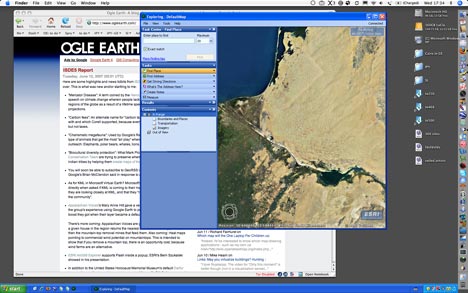
I’ve spent some time playing with the new Parallels Desktop for Mac 3, a Windows (and Linux) virtualization tool for OS X that has just gained 3D graphics support. The big question: Is the 3D graphics support compatible with the Windows virtual globes that have no Mac counterpart — NASA World Wind, Microsoft Virtual Earth 3D, SkylineGlobe and ESRI ArcGIS Explorer?

parallels-agx.jpg(Click to enlarge)

Alas, in a word: No. Despite trying all possible configurations for RAM and graphics memory, most of these applications either won’t run at all or run unstably. And when they do crash, they tend to take the entirety of Parallels down with it, which is not good for the virtual machine.

  • NASA World Wind: It starts up fine the first time, showing a pretty globe, but as soon as layers get turned on, things freeze and then crash.
  • Microsoft Virtual Earth 3D: VE3D balked at showing a globe, citing a lack of 3D graphics support, regardless of how much graphics memory was available. There was one exception, when a 3D globe very briefly flickered onto the screen, only to disappear immediately. Interestingly, Photosynth does run on Firefox (but not IE), though it does so with some unintended artefacts on the screen (upside-down photos; Smokeonit’s got the same result).
  • ESRI ArcGIS Explorer: Works fine, as long as you don’t resize the window beyond a certain limit — the graphics won’t follow you there.
  • Skyline Globe: Works fine, just as it did with Parallels Desktop 2, but that is because it isn’t turning on 3D graphics support — it uses software rendering of the globe.

All this suggests that it is not the fault of the applications — indeed, they run well when I reboot my Mac into BootCamp mode and run Windows directly. Parallels’ 3D graphics solution feels a bit hacky — and no doubt it was a difficult feat to pull off, but in this case the end result is not usable.

Best, then, to either wait for a version of Parallels that does work as intended, or else continue to run these applications after first rebooting into Bootcamp. You could always wait for VMWare to come out with their virtualization tool, and hope their 3D graphics solution is up to scratch for virtual globes.

ISDE5 Report

Here are some highlights and news tidbits from ISDE5, which is now well and truly over. This is what was new and/or startling to me:

  • “Mercator Disease”: A term coined by the Heinz Center‘s Robert Corell in his speech on climate change wherein people lack appreciation of the polar regions of the globe as a result of a lifetime spent staring at Mercator projections.
  • “Carbon fees”: An alternate name for “carbon taxes” Goldman Sachs came up with and which Corell supported, because everyone is okay with paying fees, but not taxes.
  • “Charismatic megafauna”: Used by Google’s Rebecca Moore to describe the type of animals that get the most “air play” when it comes to environmental outreach: Elephants, polar bears, whales, lions…
  • “Biocultural diversity protection”: What Mark Plotkin and the Amazon Conservation Team are trying to preserve when they empower Amazonian indian tribes by helping them create maps of their protected areas.
  • You will soon be able to subscribe to GeoRSS in Google Earth. That’s what Google’s Brian McClendon said in response to a direct question.
  • As for KML in Microsoft Virtual Earth? Microsoft’s Bill Gail did not answer “yes” directly when asked if KML is coming to their mapping app, but did say that they are looking closely at KML, and that they “realize the importance of KML in the community”.
  • Appalachian Voices‘s Mary Anne Hitt gave a very effective presentation about the group’s experience using Google Earth to publicize their cause, and the boost they got when their layer became a default layer in Google Earth.

    There’s more coming: Appalachian Voices are going to build a service that for a given house in the region returns the nearest coal-fired electricity plants, and then the mountain-top removal mines that feed them. Also coming: Heat maps pointing to commercial wind potential on mountaintops. This is intended to show that if you remove a mountain top, there is an opportunity cost, because wind farms are an alternative.

  • ESRI ArcGIS Explorer supports Flash inside a popup, ESRI’s Bern Szukalski showed in his presentation.
  • In addition to the United States Holocaust Memorial Museum’s default Darfur layer in Google Earth, and Amnesty’s web site, Microsoft’s Bill Gail announced that Microsoft had been working on a Darfur project for 8 months now, which promises realt-ime news feeds, weather and information on villages, all with GeoEye images.
  • Microsoft’s Bill Gail spent some time on the idea of connecting the exterior to the interior on a virtual globe — with as example the ability to show accurate renditions of the interiors of museums. Expect Microsoft Virtual Earth to perhaps focus more on bringing building interiors into the navigatable space.
  • Pedro Yarza from Spains AEPO demoed a cool product for visualizing the physical state of roads using Google Earth. He’s put some YouTube videos up on the session wiki where you can see this very innovative use of KML in action.
  • Andrew Fleming at the British Antarctic Survey quizzed the different virtual globe producers about the possibility of getting a better projection near the poles. Both Google Earth and Microsoft Virtual Earth currently suffer from an inability to project a layer across the poles, and the poles themselves are a nightmare.

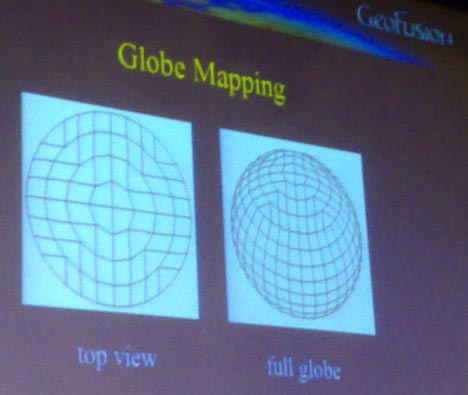
    It turns out that GeoFusion — which is more of a core 3D tools company than a end-user virtual globe creator — uses a projection that does not suffer from these drawbacks. It’s called the Geomatrix tiling system. Here is a text description, and here is a PDF description. Better yet, the ideas behind geomatrix are free for all to use, and this fact seemed to take most people at the conference by surprise. (Precise quote by Chuck Stein: “GeoFusion doesn’t claim what we do as proprietary. We would love everyone to use our model.”)

    Hopefully all this will soon lead to some decent visualization tools near the poles. Here is a snapshot from a GeoFusion slide showing what the geomatrix tiling system looks like:

20070608031.jpg

Links: Google Earth Books, Google Earth Football, TierraWiki overhaul

Live, from Napa Valley:

  • Adena Shutzberg reports from the New York State Geospatial Summit that Google Earth CTO Michael Jones previewed a feature that links locations in Google Earth to locations in Google’s scanned books. Google Earth’s timeline functionality lets you surf through the publication date of the books, and there appears to be a clever system for avoiding clutter, reports Adena.
  • Mickey Mellen, Google Earth game pioneer with GEWar and founder of Google Earth Hacks, announces a new game: Google Earth Football:

    I’m pretty sure this is the first app for Google Earth to take custom user feedback directly from within Google Earth without using the COM API or the built-in web browser. The other game we made (GEwar, a while back) relied heavily on the browser. This game runs 100% within Google Earth. If you know of other apps that do this, please let me know.

  • Mickey has also started a new blog, Digital Earth Blog. Why?

    After coming back from Where 2.0 and the Google Developer Day, I thought I’d probably have a lot to say about a variety of earth products so I started that blog. It’ll be a lot lighter on the GE stuff than you or Frank, but hopefully covering more detail about Virtual Earth, Google Maps, World Wind, etc.

  • The Times of India manages to milk the story about New York state lawmaker Michael Gianaris calling for censorhip of Google’s satellite imagery.
  • TierraWiki gets a major overhaul. Writes Tim Park:

    The major addition with this release is that we have kicked off building a digital trail database with corresponding network links into Google Earth (and Google Maps on the site). This builds on the track statistics that we had previously had by combining GPS data from the same trail to refine the internal model of the trail and provide a range of times that it has taken different trail users to complete a trail to make planning outdoor trips easier.

    This page explains how trail info is processed, which is then accessible via a KML network link covering all trails. Here is a page showing a single trail.

Media watch: Amazonian monitoring, JFK censorship not for New Yorkers

Two articles of note in today’s media:

  • The San Francisco Chronicle reports on how Google Earth is providing indigenous people in the Amazon basin with satellite imagery to help them monitor illegal logging and mining on their reserve lands. A fascinating read.
  • New York City’s NY1 television news channel reports on New York State Assemblyman Michael Gianaris’s call to censor Google imagery in the aftermath of the foiled JFK attack plan. The report also asks 4 random New Yorkers for their reaction to Gianaris’s call, and their responses make me proud to be a New Yorker: Pretty much every reason why Gianaris’s call is a bad idea is brought up by them. Watch the video for yourself.

Links: May you virtualize buildings? Hunting for Antarctic bases

  • Do Google and Microsoft have an automtic right to virtualize real buildings? The Church of England thinks Sony certainly doesn’t. I think Sony does.
  • At the bottom of this page on the Polar View website is a KML file containing every single Antarctic base out there. It’s great for finding even the best hidden bases — some of the brand-new high resolution tiles in Google Earth that look completely devoid of human habitation actually do contain a base upon closer inspection. Happy hunting.
  • GIS pro Steve0 likes GeoCommons. GIS pro James Fee doesn’t. Lively debate ensues. My take: Neogeography is here to stay. Make room for it. Dave Bouwman puts it better.
  • In February 2007, a Sudanese gun-running plane crashed at El-Geneina airport. The Register carries a breathless story about how you can see the plane on Google Earth. The only problem? Turning on the Digital Globe metadata layer shows that the imagery of the airport was taken in February 2006.
  • Google and the JFK Bomb Plot: The Censorship Circus (Lauren Weinstein’s Blog):

    Calls for massive imagery censorship, presumably to blot out every conceivable terrorist target from the public’s online view, have a certain appeal among those who always view the Internet and most of its users with suspicion. The logical outcome of this reasoning could vastly alter Google’s imagery data storage requirements — removing enough photos to make the lords of censorship happy would reduce the Google Earth file system to something akin to a single “404 Not Found” page.

  • Cato Institute’s John Harper at the National Review (!):

    Google “Get a Life”: Ignore the roar of the JFK plotters.

    Better to concede the point: Terrorists can get the same access to payment systems, health care, shoe stores, knives, computers, photography equipment, and vitamin supplements as everyone else. Google Earth, too.

    More where that came from.

  • ESRI ArcGIS Explorer gets a blog. I’d subscribe, but it doesn’t have an RSS feed.
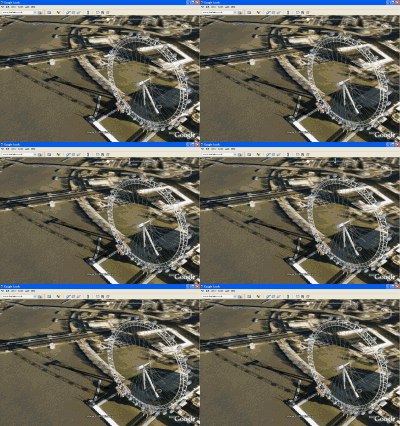
  • Extremely cool: Barnabu.co.uk uses SketchUp’s accurate daylight shadow feature to create a ground overlay for his dynamic London Eye that matches the position of the ferris wheel:

    london-eye-shadow-in-google-earth_small.gif

  • Only tangentially related to virtual globes, but: What glorious visualization! (Via Pruned)